


Material Guides
Compare representative material properties, conditions and manufacturing routes.
Values are typical references, not minimum guarantees or batch test results. They do not confirm current availability or a supply commitment. Test methods and conditions vary, and some reference values may differ by approximately 10–20%. Confirm the grade, condition, test method and supplier data for each order. Thumbnails are. Feature and process filters show source-backed matches; an untagged item is unknown, not unsuitable. Relative cost ratings compare tiers within the named material family, not prices or quotations.
CNC Metal References

6061 Aluminum
Tensile: 310 MPa; density: 2.70 g/cm³.
T6 / T651 (solution + artificial ageing); confirm exact supplier grade, state and test data.
Hardness: 95 HB.
Typical uses: Structural parts and frames, bicycle/motorcycle frames, aviation fittings, marine hardware, automation equipment, camera and optical parts, jigs and fixtures
Features: Corrosion Resistance
Relative cost within Aluminum Alloys: ★☆☆☆☆ (source tier $; ordinal reference, not a quote).
Process references (confirm for the project): CNC milling, turning, drilling, tapping (excellent machinability); sheet metal bending, stamping (T6 bending requires enlarged R); MIG/TIG welding; extrusion
Material limitations: Lower strength than 2xxx/7xxx; heat-affected zone softening after welding; T6 bending prone to cracking, requires annealing or large R corners
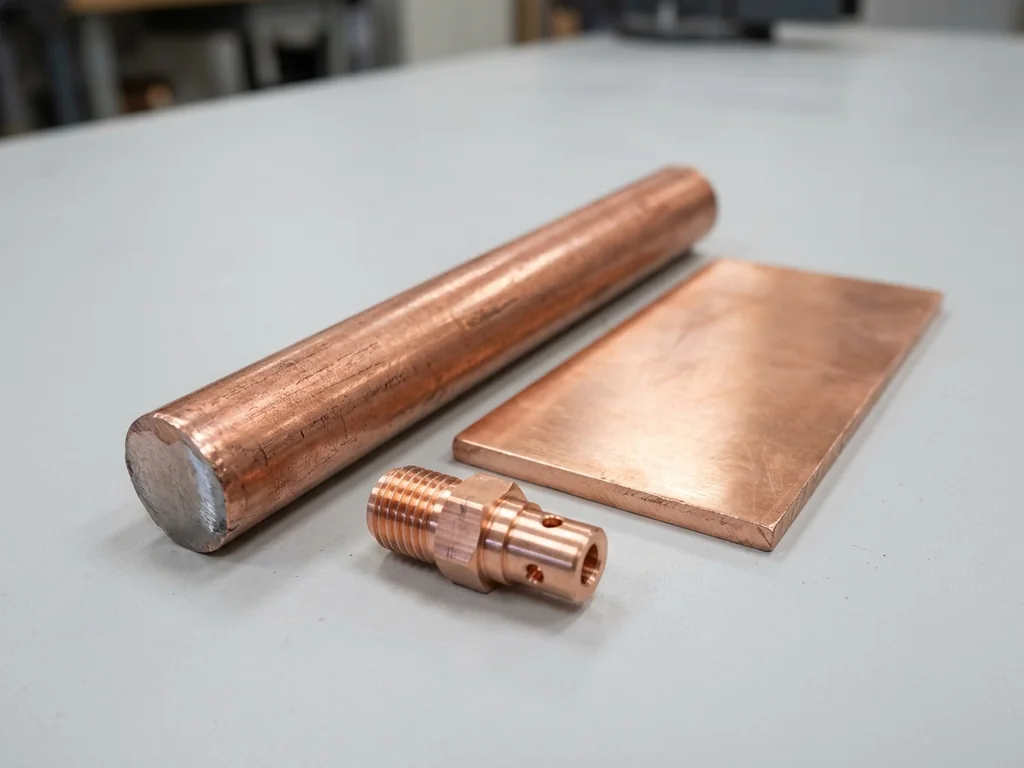
C11000 Copper
Tensile: 220–400 MPa; density: 8.89 g/cm³.
Annealed O / Drawn H (most common); confirm exact supplier grade, state and test data.
Hardness: 65–90 HB.
Typical uses: Wire, cable and busbars, heat sinks and heat exchangers, terminals and connectors, architectural decoration, piping and fittings, cookware
Features: Ductility Electrical Conductivity
Relative cost within Copper: ★☆☆☆☆ (source tier $$$; ordinal reference, not a quote).
Process references (confirm for the project): CNC milling, turning, drilling (machinability better than oxygen-free copper); sheet-metal stamping, bending, pipe bending; soldering / brazing
Material limitations: Low strength, soft, easily scratched; built-up edge in cutting; hydrogen embrittlement under high-temperature reducing atmosphere; high density
Source note: Source title and cross-reference include C110 and TU0; verify alloy and cross-standard labels before publishing exact correspondence.

C36000 Brass
Tensile: 340–470 MPa; density: 8.50 g/cm³.
Cold-drawn H (first choice for automatic lathes); confirm exact supplier grade, state and test data.
Hardness: 60–130 HB.
Typical uses: Screw-machine parts and batch fasteners, gears and valve parts, pipe fittings and connectors, pneumatic and hydraulic components, clock and instrument parts
Features: Corrosion Resistance
Source handbook cost tier: $$$ across its material table; not a within-family ranking or a quote.
Process references (confirm for the project): Automatic-lathe high-speed turning, drilling, tapping, milling (machinability benchmark = 100%)
Material limitations: Contains lead, does not meet RoHS / food / drinking-water requirements (low-lead alternatives such as C69300 needed); not weldable; hot-short
Process conditions or limitations: Welding and Assembly: not suitable for welding or hot forging; Forging: not suitable for welding or hot forging

C90300 Tin Bronze
Tensile: 255–330 MPa; density: 8.70 g/cm³.
As-cast (sand / centrifugal / continuous casting); confirm exact supplier grade, state and test data.
Hardness: 60–95 HB.
Typical uses: Bearings and bushes, sleeves and slide plates, gears and worms, pump and valve bodies, marine propellers and seawater pump parts
Features: Corrosion Resistance
Source handbook cost tier: $$$ across its material table; not a within-family ranking or a quote.
Process references (confirm for the project): CNC turning, milling, boring (finish machining of castings); grinding; brazing
Material limitations: Lower strength than aluminium bronze; castings prone to segregation and shrinkage porosity; high cost; not resistant to strong oxidising acids
Process conditions or limitations: Stamping and Deep Drawing: not suitable for stamping

1045 Carbon Steel
Tensile: 620–750 MPa; density: 7.85 g/cm³.
Hot-rolled / normalised / quenched & tempered (QT); confirm exact supplier grade, state and test data.
Hardness: 170–210 HB (≈28–35 HRC after Q&T).
Typical uses: Shafts and gears, connecting rods and cranks, hydraulic cylinder piston rods, mould base plates, bolts, agricultural and construction machinery parts
Characteristics: Can be strengthened by quenching and tempering; surface hardening improves wear resistance.
Source handbook cost tier: $ across its material table; not a within-family ranking or a quote.
Process references (confirm for the project): CNC turning, milling, drilling, grinding; welding (preheat 150–250 °C + post-heat required); forging
Material limitations: Poor corrosion resistance; water quenching prone to cracking, requires oil or step quenching; poor weldability requires preheating; medium hardenability
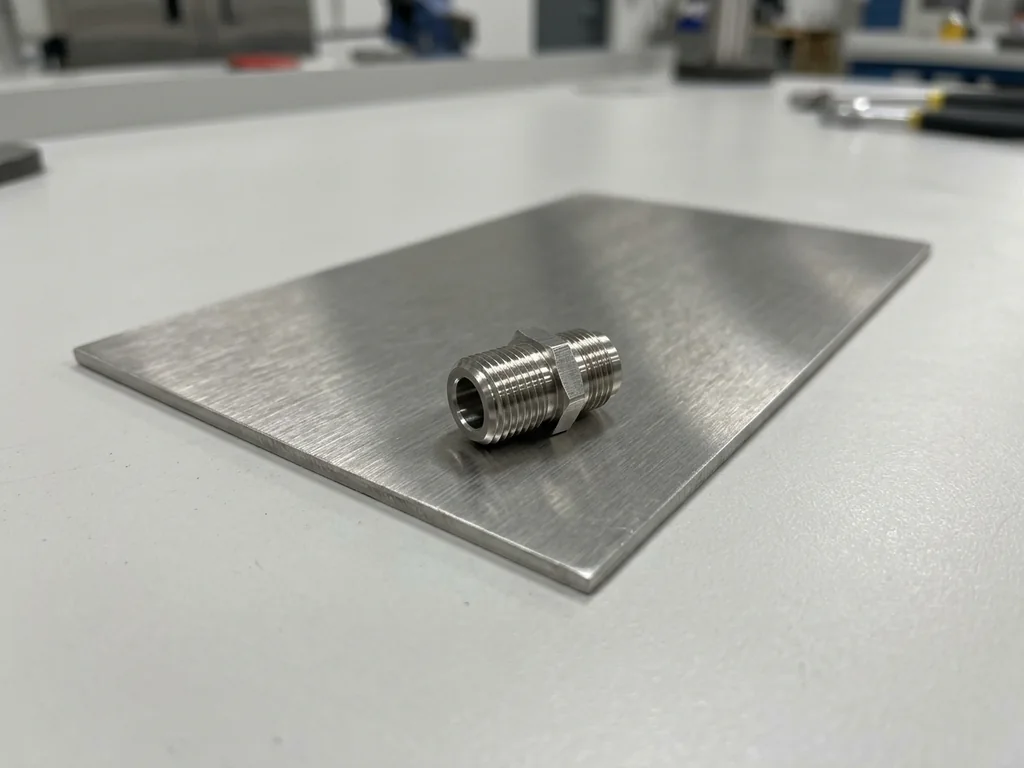
SUS304 Stainless Steel
Tensile: 505–700 MPa; density: 7.93 g/cm³.
Solution annealed, 2B / BA / No.1 / No.4; confirm exact supplier grade, state and test data.
Hardness: 170–220 HB.
Typical uses: Chemical and food equipment, pressure vessels, medical instruments, architectural decoration, household kitchen and bath, sheet-metal enclosures, fasteners
Features: Corrosion Resistance
Relative cost within Stainless Steel: ★☆☆☆☆ (source tier $$; ordinal reference, not a quote).
Process references (confirm for the project): CNC milling, turning, drilling, tapping (use low speed and high feed, avoid work hardening); grinding; sheet metal laser cutting, bending, stamping, roll bending; TIG/MIG/laser welding
Material limitations: Poor machinability (built-up edge + work hardening); prone to pitting and stress corrosion in chloride environments; no Mo, poor seawater resistance

AZ31B Magnesium
Tensile: 240–290 MPa; density: 1.77 g/cm³.
Extruded / rolled condition (H24); confirm exact supplier grade, state and test data.
Hardness: 50–70 HB.
Typical uses: Aircraft fuselage and skins, camera and laptop housings, automotive interior parts and seat frames, portable device housings, sports equipment
Characteristics: Low density, high specific strength and good machinability; magnesium swarf needs fire precautions.
Source handbook cost tier: $$$$$ across its material table; not a within-family ranking or a quote.
Process references (confirm for the project): CNC milling, turning, drilling (excellent machinability, low cutting force, long tool life); sheet metal stamping (requires heating); rolling/extrusion forming
Material limitations: Chips and dust highly flammable (Class D extinguisher required, standing water strictly prohibited); poor corrosion resistance requiring surface treatment; absolute strength lower than aluminum/steel
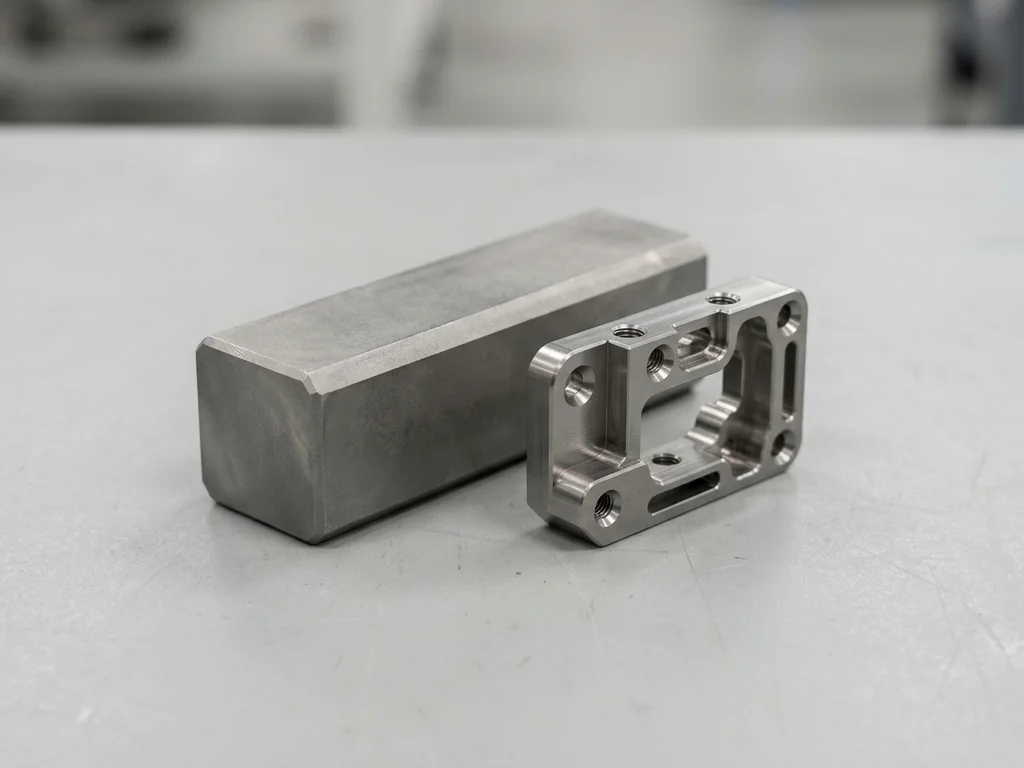
Ti-6Al-4V Grade 5 Entry
Tensile: 895–1000 MPa; density: 4.43 g/cm³.
Annealed / Solution-Treated-and-Aged (STA) / 3D-printed condition; confirm exact supplier grade, state and test data.
Hardness: 330–340 HB (≈33–36 HRC).
Typical uses: Aero-engine and airframe structural parts, landing gear, medical implants (artificial joints/bone plates), racing connecting rods and valves, marine propeller shafts, chemical corrosion-resistant parts, high-end sports equipment, 3D-printed aerospace parts
Features: Corrosion Resistance Heat Resistance
Source handbook cost tier: $$$$$ across its material table; not a within-family ranking or a quote.
Process references (confirm for the project): CNC milling, turning, drilling (low speed, high torque, sharp coated carbide + high-pressure coolant); grinding; superplastic forming/diffusion bonding (SPF/DB); laser powder-bed fusion 3D printing
Material limitations: Most expensive; extremely poor thermal conductivity causes high cutting temperature, fast tool wear, machining efficiency only 1/5 of aluminum; high chemical activity readily reacts with tool/gas; high cutting force, prone to residual stress
CNC Plastic References

ABS Reference
Tensile: 40–55 MPa; density: 1.04 g/cm³.
Extruded sheet / injection-moulding grade; confirm exact supplier grade, state and test data.
Hardness: Rockwell R99–110; confirm grade and supplier data.
Typical uses: Prototypes and appearance models, electronic/electrical enclosures and panels, automotive interior parts, toys (LEGO), appliance housings, pipes and fittings, luggage
Features: Dimensional Stability
Relative cost within Commodity Plastics: ★★★★★ (source tier $$; ordinal reference, not a quote).
Process references (confirm for the project): CNC milling, turning, drilling, tapping; adhesive bonding (solvent/adhesive);ultrasonic welding; injection moulding; hot bending/thermoforming
Material limitations: Limited heat resistance (HDT ≈95 °C); poor weather and UV resistance (prone to yellowing); not resistant to organic solvents (acetone/banana oil); flammable (HB rating)

PC Reference
Tensile: 60–72 MPa; density: 1.20 g/cm³.
Extruded sheet / injection-moulding grade; confirm exact supplier grade, state and test data.
Hardness: M70 / R118 / Shore D 85–90.
Typical uses: Safety goggles and face shields; riot shields and police equipment; lamp housings and optical lenses; electronic enclosures; greenhouses and glazing/skylight panels; medical devices
Features: Dimensional Stability Heat Resistance
Relative cost within Engineering Plastics: ★★★☆☆ (source tier $$; ordinal reference, not a quote).
Process references (confirm for the project): CNC milling, turning, drilling, tapping; adhesive bonding (solvent/adhesive);ultrasonic welding; injection moulding; hot bending/thermoforming;hot bending
Material limitations: Low surface hardness, easily scratched (hard coat often required); poor chemical/stress-crack resistance (greases/solvents); UV-sensitive, requires coating; high cost
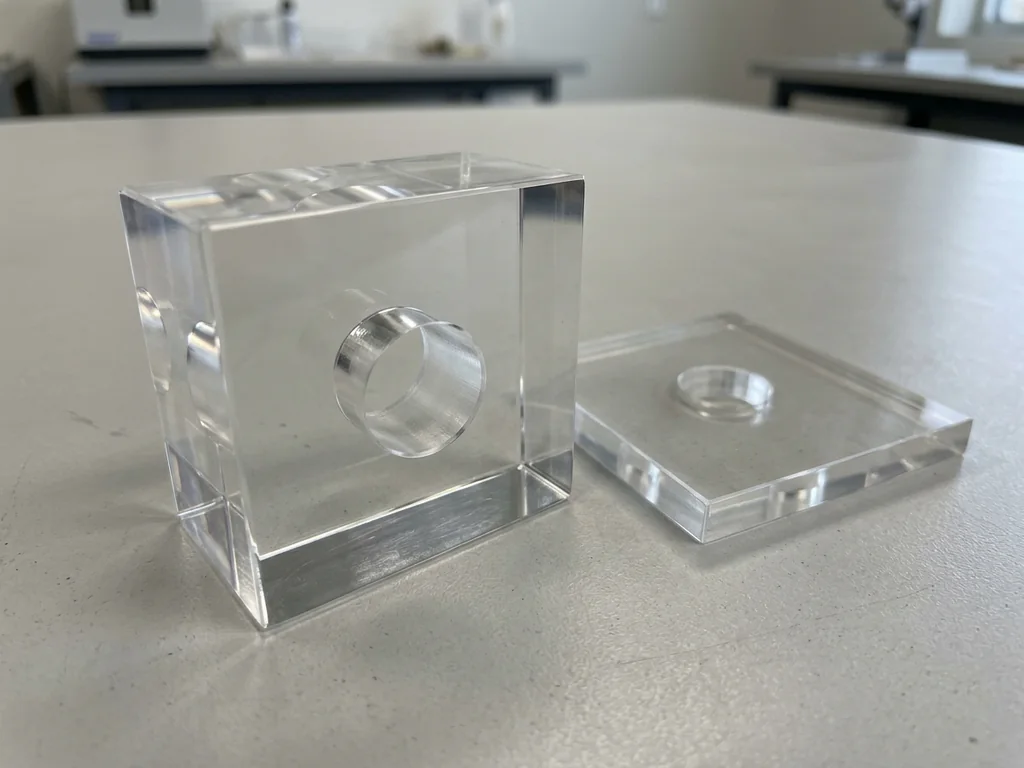
PMMA Reference
Tensile: 65–80 MPa; density: 1.18 g/cm³.
Cast sheet / extruded sheet / injection-moulding grade; confirm exact supplier grade, state and test data.
Hardness: M85–105 / R124 / Shore D 90–95.
Typical uses: Optical lenses and light guides; display stands and signage; lamp housings and lighting diffusers; aquariums and viewing windows; medical device housings; instrument panel covers
Characteristics: High optical clarity, UV resistance and a polishable surface.
Relative cost within Engineering Plastics: ★☆☆☆☆ (source tier $; ordinal reference, not a quote).
Process references (confirm for the project): CNC milling, turning, drilling, tapping; diamond polishing; adhesive bonding (solvent/adhesive);ultrasonic welding; injection moulding; hot bending/thermoforming;hot bending (~150 °C)
Material limitations: Brittle, notch-impact sensitive (prone to chipping); poor solvent resistance (alcohol/acetone cause crazing); moderate heat resistance (HDT ~95 °C)

POM-C Reference
Tensile: 65–72 MPa; density: 1.41 g/cm³.
Extruded sheet / rod / injection-moulding grade; confirm exact supplier grade, state and test data.
Hardness: R115–120 / Shore D 80–85.
Typical uses: Precision gears and racks; bearings and bushings; sliding guides; pump and valve parts; zippers and fasteners; automotive door locks and seat-belt components; medical devices
Features: Creep Resistance Dimensional Stability Fatigue Resistance
Relative cost within Engineering Plastics: ★★★☆☆ (source tier $$; ordinal reference, not a quote).
Process references (confirm for the project): CNC turning, milling, drilling, tapping (best machinability among engineering plastics, mirror finish achievable); injection moulding
Material limitations: Poor weather/UV resistance (prone to chalking); not resistant to strong acids, strong alkalis and chlorinated solvents; formaldehyde released on heating, requires ventilation; high shrinkage (~2%)

PA6 Reference
Yield: 70–90 MPa (dry as moulded); density: 1.14 g/cm³. Moisture state affects properties.
PA6 cast/extruded/injection-grade source entry; shown yield is dry-as-moulded. Confirm moisture and ordered state.
Hardness: Shore D 78–82 / R110.
Typical uses: Gears and pulleys; bearings and bearing shells; conveyor belts and guides; automotive under-hood components; textile machinery parts; electronic connectors
Features: Chemical Resistance
Relative cost within Engineering Plastics: ★★★☆☆ (source tier $$; ordinal reference, not a quote).
Process references (confirm for the project): CNC milling, turning, drilling; injection moulding; rolling and thermoforming (dry as moulded)
Material limitations: Strong moisture absorption (dimensions and properties vary greatly with humidity); brittle in dry-as-moulded state; poor acid resistance; moderate UV and heat resistance

HDPE Reference
Tensile: 26–33 MPa; density: 0.95 g/cm³.
Extruded sheet/rod / injection-moulding grade / blow-moulding grade; confirm exact supplier grade, state and test data.
Hardness: Shore D 65–70.
Typical uses: Pipes and fittings (water supply/drainage/gas), chemical storage tanks and linings, food and pharmaceutical packaging, playground equipment, dock fenders, waste bins
Features: Chemical Resistance Cost Effective
Relative cost within Commodity Plastics: ★☆☆☆☆ (source tier $; ordinal reference, not a quote).
Process references (confirm for the project): CNC milling, turning, drilling, tapping; adhesive bonding (solvent/adhesive);ultrasonic welding;plastic welding (hot-plate welding/plastic welding;excellent weldability); injection and blow moulding; hot bending/thermoforming;injection and blow moulding
Material limitations: Low strength and stiffness; low heat resistance (HDT ≈80 °C); prone to stress cracking (ESC); difficult to bond/paint; poor creep resistance

Unfilled PEEK Reference
Tensile: 90–100 MPa; density: 1.31 g/cm³.
Extruded sheet and rod / injection-moulding grade; confirm exact supplier grade, state and test data.
Hardness: Shore D 85–90 / R126.
Typical uses: Aerospace structural parts and clamps; medical implants and surgical instruments; semiconductor fixtures (CMP rings/wafer carriers); oil and gas seals; bearing cages
Features: Chemical Resistance Dimensional Stability Flame Resistance Heat Resistance
Relative cost within High-Performance Plastics: ★★★★★ (source tier $$$$$; ordinal reference, not a quote).
Process references (confirm for the project): CNC milling, turning, drilling (high toughness, requires sharp tooling + adequate cooling); grinding; injection moulding (barrel 380–400 °C)
Material limitations: Most expensive (about 20–30× POM); processing requires high temperature and dedicated tooling; only beige/black colour options
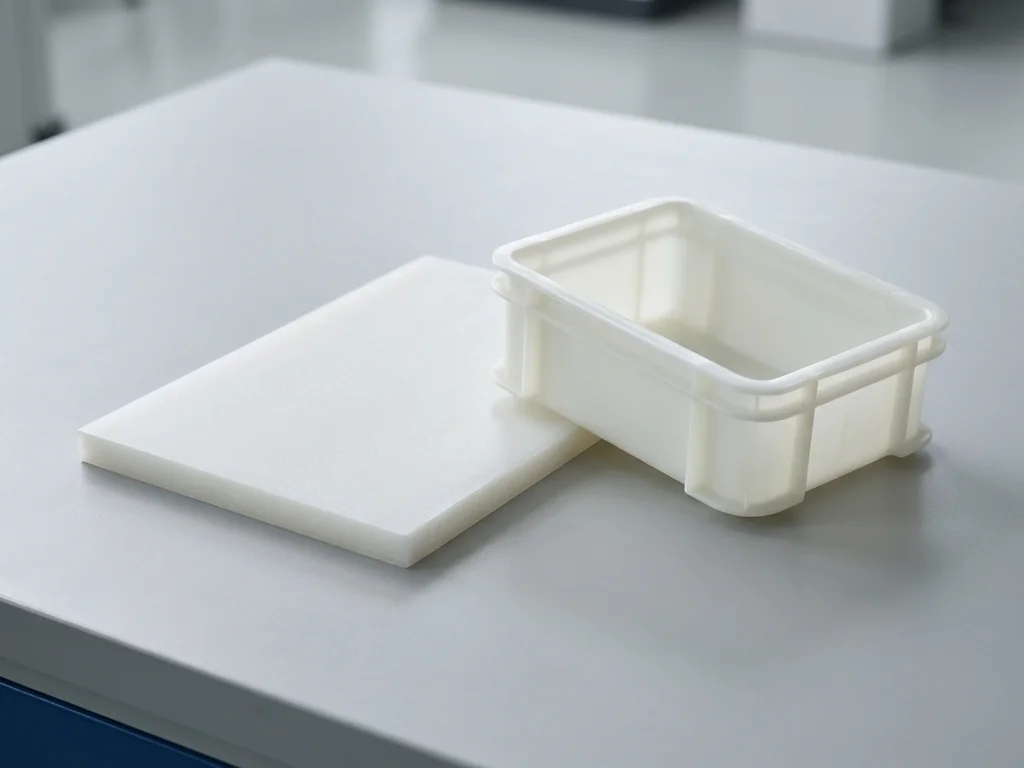
PP Reference
Tensile: 30–40 MPa; density: 0.91 g/cm³.
Extruded sheet/rod / injection-moulding grade; confirm exact supplier grade, state and test data.
Hardness: R80–100 / Shore D 70–75.
Typical uses: Chemical storage tanks and piping, laboratory ware and consumables, automotive bumpers and interiors, food packaging, electronic enclosures, wastewater treatment equipment
Features: Chemical Resistance Cost Effective Fatigue Resistance
Relative cost within Commodity Plastics: ★☆☆☆☆ (source tier $; ordinal reference, not a quote).
Process references (confirm for the project): CNC milling, turning, drilling, tapping; adhesive bonding (solvent/adhesive);ultrasonic welding;plastic welding (hot-gas welding/hot-plate welding;best weldability); injection moulding; hot bending/thermoforming;thermoforming
Material limitations: Low strength and stiffness; brittle at low temperature (homopolymer below 0 °C); difficult to bond and paint (surface treatment required); moderate heat and weather resistance
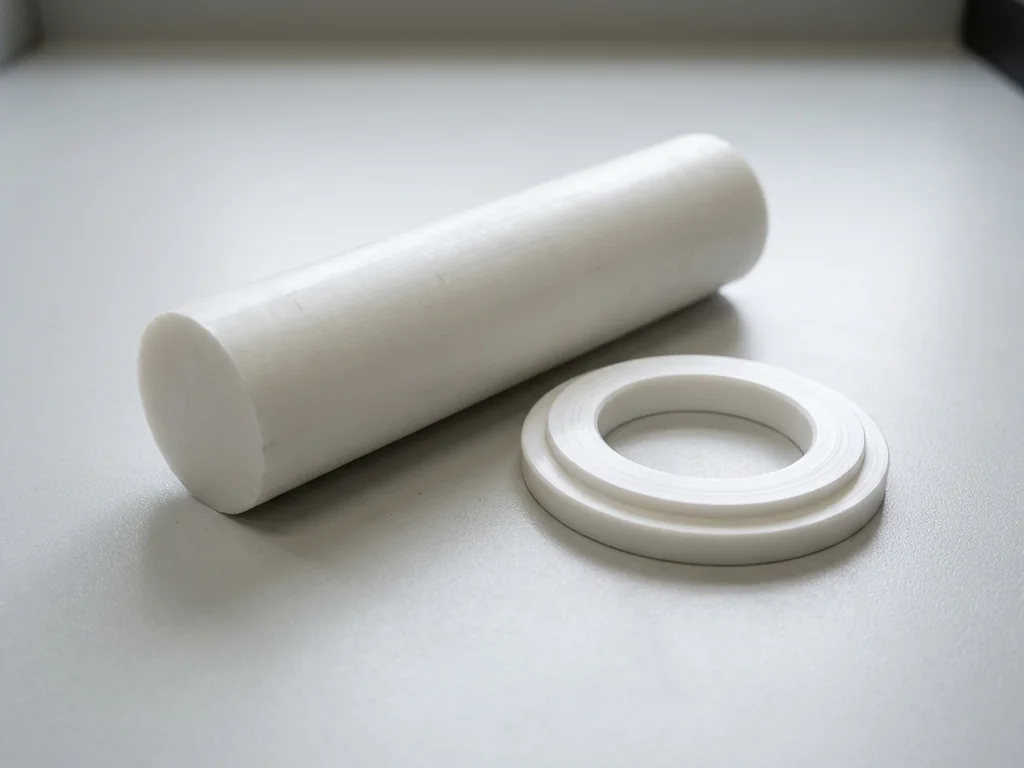
PTFE Reference
Tensile: 20–35 MPa; density: 2.17 g/cm³.
Compression-sintered PTFE stock; not ordinary melt injection. Review the required forming or machining process separately.
Hardness: Shore D 50–65.
Typical uses: Seals and gaskets; valve seats and packings; bearings and slide rails; chemical-pipe linings and anti-corrosion layers; non-stick coatings; high-frequency cable insulation; medical catheters
Features: Chemical Resistance Electrical Insulation
Relative cost within High-Performance Plastics: ★☆☆☆☆ (source tier $$; ordinal reference, not a quote).
Process references (confirm for the project): CNC turning, milling (soft and prone to creep, requires very sharp tooling + low speed); stamping; compression moulding + sintering at 360–380 °C
Material limitations: Very low strength and stiffness, severe cold flow (creep); not melt-processable (sintering only); high linear expansion; poor wear resistance (pure PTFE); high cost
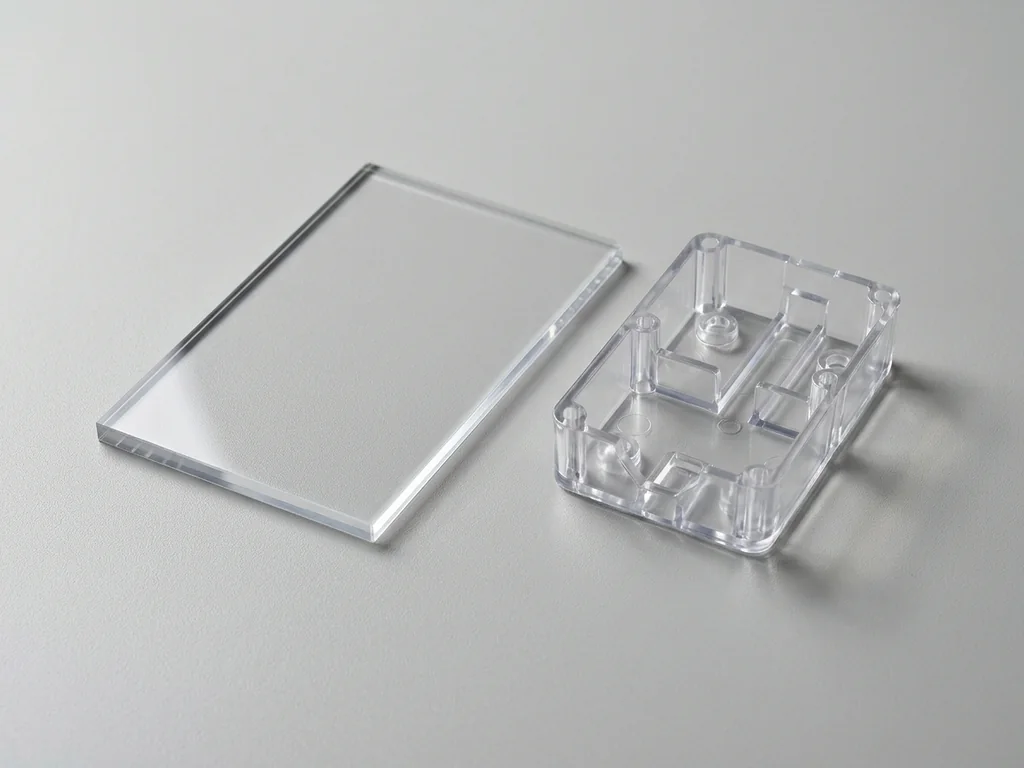
GPPS Reference
Tensile: 27–55 MPa; density: 1.05 g/cm³.
Extruded sheet / injection-moulding grade; confirm exact supplier grade, state and test data.
Hardness: R70–90 / M65–80.
Typical uses: Disposable packaging and vacuum-formed trays, display models and prototypes, insulating parts, toys, lampshades, petri dishes (laboratory)
Features: Cost Effective Dimensional Stability Electrical Insulation
Relative cost within Commodity Plastics: ★☆☆☆☆ (source tier $; ordinal reference, not a quote).
Process references (confirm for the project): CNC milling, turning, drilling, tapping; adhesive bonding (solvent/adhesive);ultrasonic welding;solvent bonding; injection moulding; hot bending/thermoforming;thermoforming (vacuum forming, excellent)
Material limitations: Extremely brittle (lowest impact strength among common plastics); low heat resistance (HDT ≈80 °C); not resistant to solvents and UV; prone to stress cracking
Plastics for molding process review
ABS Reference
Tensile: 40–55 MPa; density: 1.04 g/cm³.
Extruded sheet / injection-moulding grade; confirm exact supplier grade, state and test data.
Hardness: Rockwell R99–110; confirm grade and supplier data.
Typical uses: Prototypes and appearance models, electronic/electrical enclosures and panels, automotive interior parts, toys (LEGO), appliance housings, pipes and fittings, luggage
Features: Dimensional Stability
Relative cost within Commodity Plastics: ★★★★★ (source tier $$; ordinal reference, not a quote).
Process references (confirm for the project): CNC milling, turning, drilling, tapping; adhesive bonding (solvent/adhesive);ultrasonic welding; injection moulding; hot bending/thermoforming
Material limitations: Limited heat resistance (HDT ≈95 °C); poor weather and UV resistance (prone to yellowing); not resistant to organic solvents (acetone/banana oil); flammable (HB rating)
PC Reference
Tensile: 60–72 MPa; density: 1.20 g/cm³.
Extruded sheet / injection-moulding grade; confirm exact supplier grade, state and test data.
Hardness: M70 / R118 / Shore D 85–90.
Typical uses: Safety goggles and face shields; riot shields and police equipment; lamp housings and optical lenses; electronic enclosures; greenhouses and glazing/skylight panels; medical devices
Features: Dimensional Stability Heat Resistance
Relative cost within Engineering Plastics: ★★★☆☆ (source tier $$; ordinal reference, not a quote).
Process references (confirm for the project): CNC milling, turning, drilling, tapping; adhesive bonding (solvent/adhesive);ultrasonic welding; injection moulding; hot bending/thermoforming;hot bending
Material limitations: Low surface hardness, easily scratched (hard coat often required); poor chemical/stress-crack resistance (greases/solvents); UV-sensitive, requires coating; high cost
PA6 Reference
Yield: 70–90 MPa (dry as moulded); density: 1.14 g/cm³. Moisture state affects properties.
PA6 cast/extruded/injection-grade source entry; shown yield is dry-as-moulded. Confirm moisture and ordered state.
Hardness: Shore D 78–82 / R110.
Typical uses: Gears and pulleys; bearings and bearing shells; conveyor belts and guides; automotive under-hood components; textile machinery parts; electronic connectors
Features: Chemical Resistance
Relative cost within Engineering Plastics: ★★★☆☆ (source tier $$; ordinal reference, not a quote).
Process references (confirm for the project): CNC milling, turning, drilling; injection moulding; rolling and thermoforming (dry as moulded)
Material limitations: Strong moisture absorption (dimensions and properties vary greatly with humidity); brittle in dry-as-moulded state; poor acid resistance; moderate UV and heat resistance
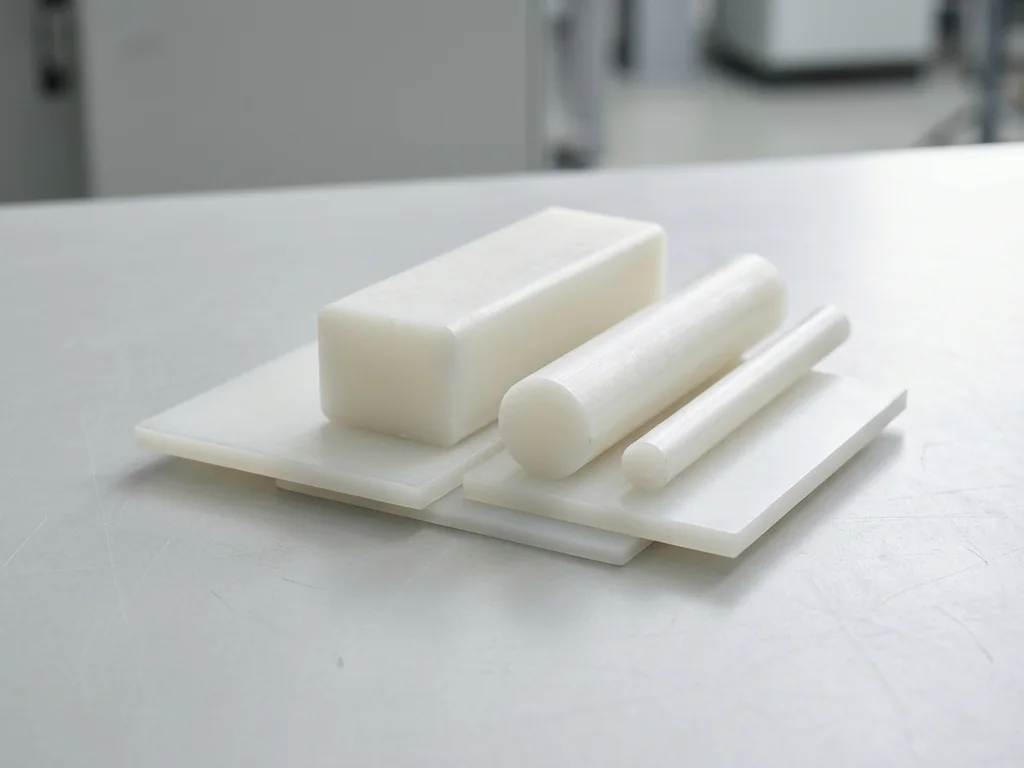
PE Grade Comparison
HDPE: tensile 26–33 MPa, density 0.95 g/cm³; LDPE: tensile 7–15 MPa, density 0.92 g/cm³.
HDPE and LDPE are separate source entries with different stock forms and grade conditions. The ordered PE grade needs verification against supplier data.
Hardness: HDPE (High-Density Polyethylene): Shore D 65–70; LDPE (Low-Density Polyethylene): Shore D 40–50 / R20–40.
Typical uses: HDPE (High-Density Polyethylene): Pipes and fittings (water supply/drainage/gas), chemical storage tanks and linings, food and pharmaceutical packaging, playground equipment, dock fenders, waste bins; LDPE (Low-Density Polyethylene): Packaging film and plastic bags, hoses and tubing, cable sheathing, container caps and seals, toys and household goods, coatings
Features: Chemical Resistance Cost Effective
Source handbook cost tier: $ across its material table; not a within-family ranking or a quote.
Process references (confirm for the project): CNC milling, turning, drilling, tapping; adhesive bonding (solvent/adhesive);ultrasonic welding;plastic welding (hot-plate welding/plastic welding;excellent weldability); injection and blow moulding; hot bending/thermoforming;injection and blow moulding; adhesive bonding (solvent/adhesive);ultrasonic welding;heat sealing (best sealability); film blowing and injection moulding; hot bending/thermoforming;film blowing and injection moulding
Material limitations: HDPE (High-Density Polyethylene): Low strength and stiffness; low heat resistance (HDT ≈80 °C); prone to stress cracking (ESC); difficult to bond/paint; poor creep resistance; LDPE (Low-Density Polyethylene): Very low strength and stiffness; lowest heat resistance (HDT 40–50 °C); poor weather/UV resistance; high gas permeability, poor barrier properties
PMMA Reference
Tensile: 65–80 MPa; density: 1.18 g/cm³.
Cast sheet / extruded sheet / injection-moulding grade; confirm exact supplier grade, state and test data.
Hardness: M85–105 / R124 / Shore D 90–95.
Typical uses: Optical lenses and light guides; display stands and signage; lamp housings and lighting diffusers; aquariums and viewing windows; medical device housings; instrument panel covers
Characteristics: High optical clarity, UV resistance and a polishable surface.
Relative cost within Engineering Plastics: ★☆☆☆☆ (source tier $; ordinal reference, not a quote).
Process references (confirm for the project): CNC milling, turning, drilling, tapping; diamond polishing; adhesive bonding (solvent/adhesive);ultrasonic welding; injection moulding; hot bending/thermoforming;hot bending (~150 °C)
Material limitations: Brittle, notch-impact sensitive (prone to chipping); poor solvent resistance (alcohol/acetone cause crazing); moderate heat resistance (HDT ~95 °C)
POM-C Reference
Tensile: 65–72 MPa; density: 1.41 g/cm³.
Extruded sheet / rod / injection-moulding grade; confirm exact supplier grade, state and test data.
Hardness: R115–120 / Shore D 80–85.
Typical uses: Precision gears and racks; bearings and bushings; sliding guides; pump and valve parts; zippers and fasteners; automotive door locks and seat-belt components; medical devices
Features: Creep Resistance Dimensional Stability Fatigue Resistance
Relative cost within Engineering Plastics: ★★★☆☆ (source tier $$; ordinal reference, not a quote).
Process references (confirm for the project): CNC turning, milling, drilling, tapping (best machinability among engineering plastics, mirror finish achievable); injection moulding
Material limitations: Poor weather/UV resistance (prone to chalking); not resistant to strong acids, strong alkalis and chlorinated solvents; formaldehyde released on heating, requires ventilation; high shrinkage (~2%)
Unfilled PEEK Reference
Tensile: 90–100 MPa; density: 1.31 g/cm³.
Extruded sheet and rod / injection-moulding grade; confirm exact supplier grade, state and test data.
Hardness: Shore D 85–90 / R126.
Typical uses: Aerospace structural parts and clamps; medical implants and surgical instruments; semiconductor fixtures (CMP rings/wafer carriers); oil and gas seals; bearing cages
Features: Chemical Resistance Dimensional Stability Flame Resistance Heat Resistance
Relative cost within High-Performance Plastics: ★★★★★ (source tier $$$$$; ordinal reference, not a quote).
Process references (confirm for the project): CNC milling, turning, drilling (high toughness, requires sharp tooling + adequate cooling); grinding; injection moulding (barrel 380–400 °C)
Material limitations: Most expensive (about 20–30× POM); processing requires high temperature and dedicated tooling; only beige/black colour options

PBT Reference
Tensile: 50–70 MPa; density: 1.32 g/cm³.
Injection-moulding grade / extruded rod; confirm exact supplier grade, state and test data.
Hardness: R115–125 / Shore D 85–90.
Typical uses: Automotive electrical connectors and sensor housings; relays and switches; appliance housings and handles; fibre-optic secondary coating; gears and cams; power-tool parts
Features: Chemical Resistance Dimensional Stability Electrical Insulation Heat Resistance
Relative cost within Engineering Plastics: ★★★☆☆ (source tier $$; ordinal reference, not a quote).
Process references (confirm for the project): CNC milling, turning; ultrasonic welding; injection moulding (excellent flow, suitable for thin-wall and precision parts)
Material limitations: Notch-impact sensitive; unfilled parts have only moderate stiffness; sensitive to high-temperature hydrolysis (must be dried); poor resistance to strong alkalis and prolonged hot water
PP Reference
Tensile: 30–40 MPa; density: 0.91 g/cm³.
Extruded sheet/rod / injection-moulding grade; confirm exact supplier grade, state and test data.
Hardness: R80–100 / Shore D 70–75.
Typical uses: Chemical storage tanks and piping, laboratory ware and consumables, automotive bumpers and interiors, food packaging, electronic enclosures, wastewater treatment equipment
Features: Chemical Resistance Cost Effective Fatigue Resistance
Relative cost within Commodity Plastics: ★☆☆☆☆ (source tier $; ordinal reference, not a quote).
Process references (confirm for the project): CNC milling, turning, drilling, tapping; adhesive bonding (solvent/adhesive);ultrasonic welding;plastic welding (hot-gas welding/hot-plate welding;best weldability); injection moulding; hot bending/thermoforming;thermoforming
Material limitations: Low strength and stiffness; brittle at low temperature (homopolymer below 0 °C); difficult to bond and paint (surface treatment required); moderate heat and weather resistance
PTFE: Separate Process Review
Tensile: 20–35 MPa; density: 2.17 g/cm³.
Compression-sintered PTFE stock; not ordinary melt injection. Review the required forming or machining process separately.
Hardness: Shore D 50–65.
Typical uses: Seals and gaskets; valve seats and packings; bearings and slide rails; chemical-pipe linings and anti-corrosion layers; non-stick coatings; high-frequency cable insulation; medical catheters
Features: Chemical Resistance Electrical Insulation
Relative cost within High-Performance Plastics: ★☆☆☆☆ (source tier $$; ordinal reference, not a quote).
Process references (confirm for the project): CNC turning, milling (soft and prone to creep, requires very sharp tooling + low speed); stamping; compression moulding + sintering at 360–380 °C
Material limitations: Very low strength and stiffness, severe cold flow (creep); not melt-processable (sintering only); high linear expansion; poor wear resistance (pure PTFE); high cost
HDPE Reference
Tensile: 26–33 MPa; density: 0.95 g/cm³.
Extruded sheet/rod / injection-moulding grade / blow-moulding grade; confirm exact supplier grade, state and test data.
Hardness: Shore D 65–70.
Typical uses: Pipes and fittings (water supply/drainage/gas), chemical storage tanks and linings, food and pharmaceutical packaging, playground equipment, dock fenders, waste bins
Features: Chemical Resistance Cost Effective
Relative cost within Commodity Plastics: ★☆☆☆☆ (source tier $; ordinal reference, not a quote).
Process references (confirm for the project): CNC milling, turning, drilling, tapping; adhesive bonding (solvent/adhesive);ultrasonic welding;plastic welding (hot-plate welding/plastic welding;excellent weldability); injection and blow moulding; hot bending/thermoforming;injection and blow moulding
Material limitations: Low strength and stiffness; low heat resistance (HDT ≈80 °C); prone to stress cracking (ESC); difficult to bond/paint; poor creep resistance
GPPS Reference
Tensile: 27–55 MPa; density: 1.05 g/cm³.
Extruded sheet / injection-moulding grade; confirm exact supplier grade, state and test data.
Hardness: R70–90 / M65–80.
Typical uses: Disposable packaging and vacuum-formed trays, display models and prototypes, insulating parts, toys, lampshades, petri dishes (laboratory)
Features: Cost Effective Dimensional Stability Electrical Insulation
Relative cost within Commodity Plastics: ★☆☆☆☆ (source tier $; ordinal reference, not a quote).
Process references (confirm for the project): CNC milling, turning, drilling, tapping; adhesive bonding (solvent/adhesive);ultrasonic welding;solvent bonding; injection moulding; hot bending/thermoforming;thermoforming (vacuum forming, excellent)
Material limitations: Extremely brittle (lowest impact strength among common plastics); low heat resistance (HDT ≈80 °C); not resistant to solvents and UV; prone to stress cracking
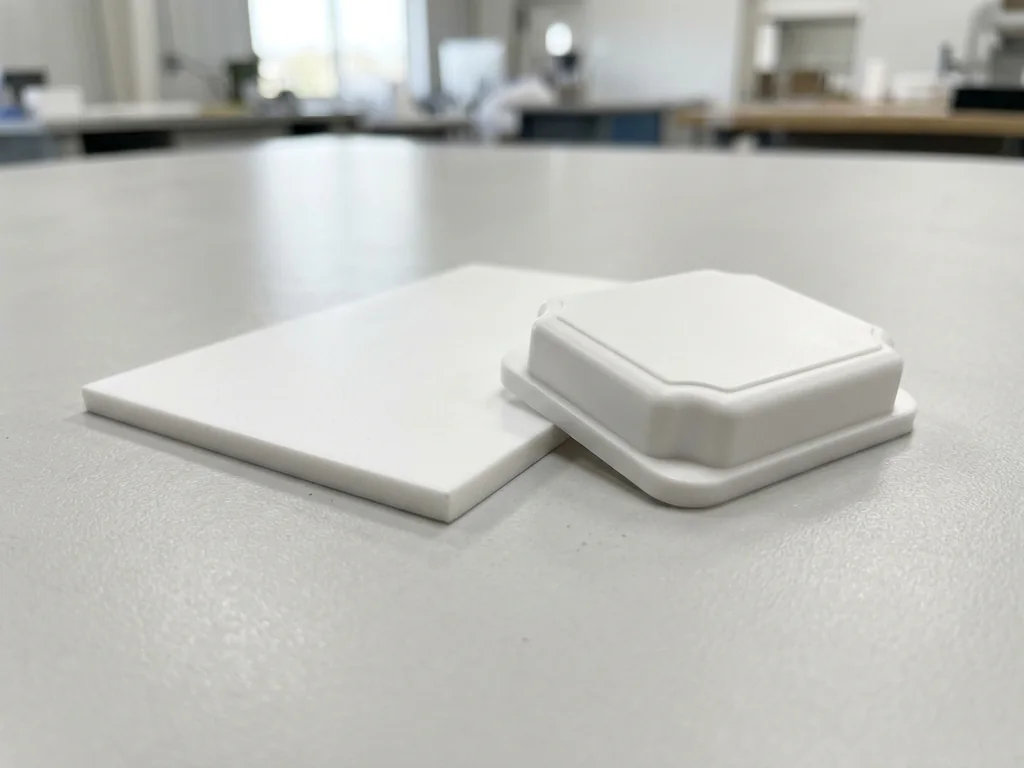
HIPS Reference
Tensile: 22–35 MPa; density: 1.05 g/cm³.
Extruded sheet / injection-moulding grade; confirm exact supplier grade, state and test data.
Hardness: R95–105 / Shore D 70–80.
Typical uses: Appliance liners and housings, display racks and POP boards, toys and models, refrigerator liners (vacuum formed), packaging inserts, prototypes
Features: Cost Effective
Relative cost within Commodity Plastics: ★☆☆☆☆ (source tier $; ordinal reference, not a quote).
Process references (confirm for the project): CNC milling, turning, drilling, tapping; adhesive bonding (solvent/adhesive);ultrasonic welding;solvent bonding; injection moulding; hot bending/thermoforming;vacuum forming (excellent formability)
Material limitations: Opaque (loses PS's transparency); low heat resistance; poor weather/UV resistance, prone to yellowing; poor solvent resistance

PPS Reference
Tensile: 80–110 MPa for the handbook reference; density: 1.37 g/cm³. Filled variants need separate data.
Injection-moulding grade / extruded rod; confirm exact supplier grade, state and test data.
Hardness: R90–100 / Shore D 90.
Typical uses: Automotive under-hood parts (pump housings/impellers/sensors); electrical connectors and bobbins; chemical pump valves; heat-resistant appliance parts; SMT fixtures
Features: Chemical Resistance Dimensional Stability Flame Resistance Heat Resistance
Relative cost within High-Performance Plastics: ★★★☆☆ (source tier $$$; ordinal reference, not a quote).
Process references (confirm for the project): CNC milling, drilling (high glass-fibre abrasiveness, requires PCD tooling); injection moulding (barrel 300–340 °C)
Material limitations: Unfilled grade is brittle (elongation at break only 1–2%); high processing temperature (300 °C+); limited colours (black/white/brown); high cost
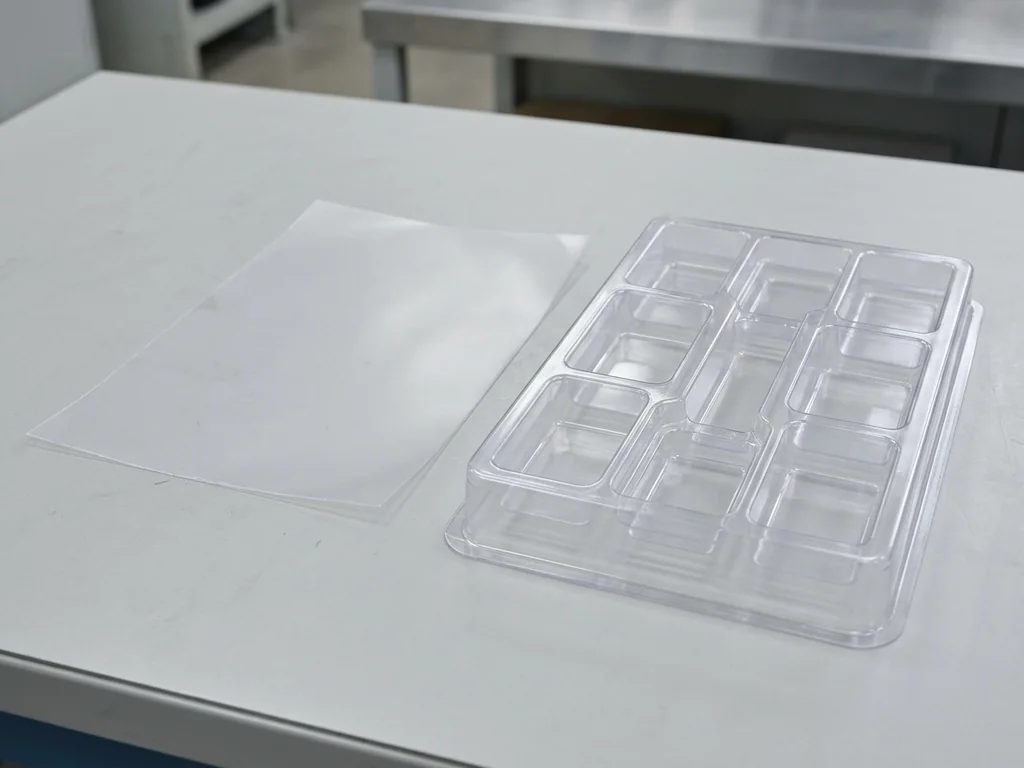
PET Reference
Tensile: 80–90 MPa; density: 1.39 g/cm³.
Injection-moulding grade / extruded sheet and rod; confirm exact supplier grade, state and test data.
Hardness: R70–80 / Shore D 85.
Typical uses: Beverage bottles and food packaging (blow moulding); gears and bearings; electrical insulation parts and connectors; automotive structural parts; textile fibres; 3D-printing filament
Features: Chemical Resistance
Relative cost within Engineering Plastics: ★☆☆☆☆ (source tier $; ordinal reference, not a quote).
Process references (confirm for the project): CNC milling, turning, drilling (glass-fibre grades require PCD tooling); injection moulding; blow moulding (preforms)
Material limitations: Low notch impact (brittle); strong moisture absorption (must be strictly dried before processing, otherwise degradation); poor resistance to hot water and strong alkalis; slow crystallisation, long moulding cycle

LDPE Reference
Tensile: 7–15 MPa; density: 0.92 g/cm³.
Extruded film / sheet / injection-moulding grade; confirm exact supplier grade, state and test data.
Hardness: Shore D 40–50 / R20–40.
Typical uses: Packaging film and plastic bags, hoses and tubing, cable sheathing, container caps and seals, toys and household goods, coatings
Features: Chemical Resistance Cost Effective Ductility
Relative cost within Commodity Plastics: ★☆☆☆☆ (source tier $; ordinal reference, not a quote).
Process references (confirm for the project): CNC milling, turning, drilling, tapping; adhesive bonding (solvent/adhesive);ultrasonic welding;heat sealing (best sealability); film blowing and injection moulding; hot bending/thermoforming;film blowing and injection moulding
Material limitations: Very low strength and stiffness; lowest heat resistance (HDT 40–50 °C); poor weather/UV resistance; high gas permeability, poor barrier properties

Rigid PVC-U Reference
Tensile: 45–60 MPa; density: 1.42 g/cm³.
Extruded sheet/rod / injection moulding / welded profiles; confirm exact supplier grade, state and test data.
Hardness: Shore D 80–85.
Typical uses: Pipes and fittings (water supply/drainage/chemical), electrical trunking and insulating boards, window/door profiles, chemical-equipment linings, advertising boards, medical tubing
Features: Chemical Resistance Cost Effective Electrical Insulation Flame Resistance
Relative cost within Commodity Plastics: ★☆☆☆☆ (source tier $; ordinal reference, not a quote).
Process references (confirm for the project): CNC milling, turning, sawing (poor thermal conductivity); solvent/hot-air welding; extrusion; thermoforming
Material limitations: Low heat resistance (HDT 60–70 °C); overheating during processing releases toxic HCl gas; contains plasticiser/chlorine, environmental concerns; moderate impact resistance
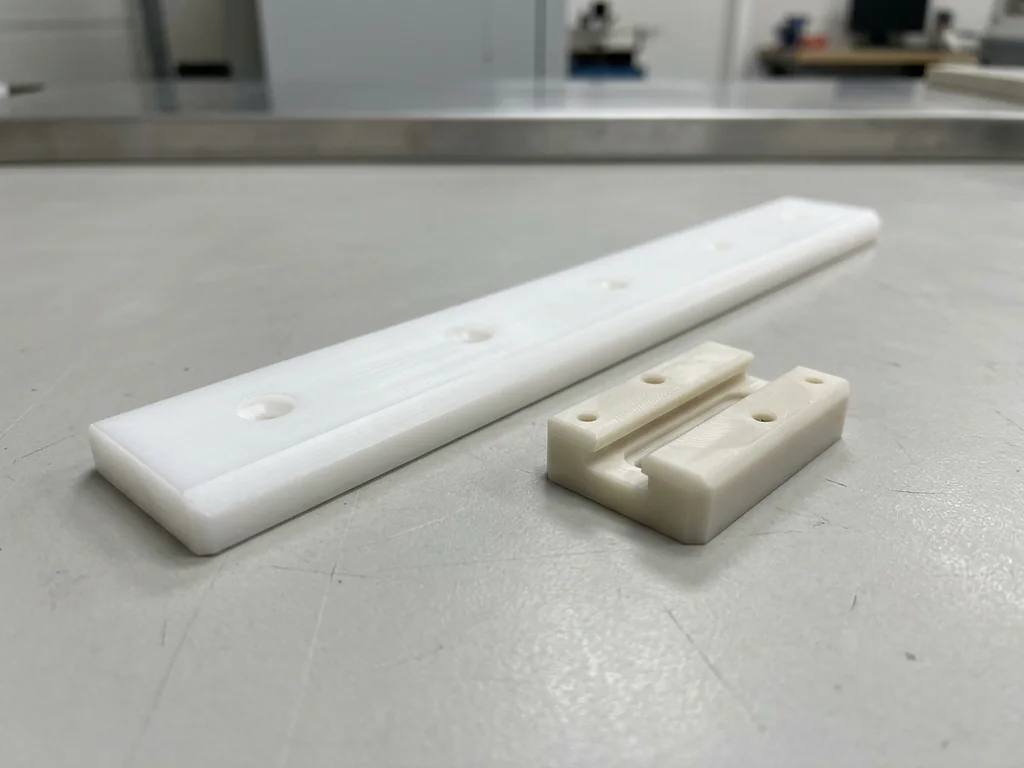
UHMWPE: Separate Process Review
Tensile: 20–40 MPa; density: 0.94 g/cm³.
UHMWPE stock/compression-sintering process reference; conventional melt injection is not assumed. Review process separately.
Hardness: R63–75 / Shore D 60–70.
Typical uses: Conveyor and guide-rail wear strips; chute and hopper liners; gears and sliders; port fender plates; artificial joints (medical grade); ski bases
Features: Chemical Resistance
Relative cost within Engineering Plastics: ★★★☆☆ (source tier $$; ordinal reference, not a quote).
Process references (confirm for the project): CNC milling, turning, sawing (soft with low melting point, requires sharp tooling + low cutting heat); stamping; compression sintering
Material limitations: Low strength and stiffness; low heat resistance (HDT ~85 °C); very high thermal expansion coefficient (machining dimensions hard to control); difficult to bond, cannot be melt-welded
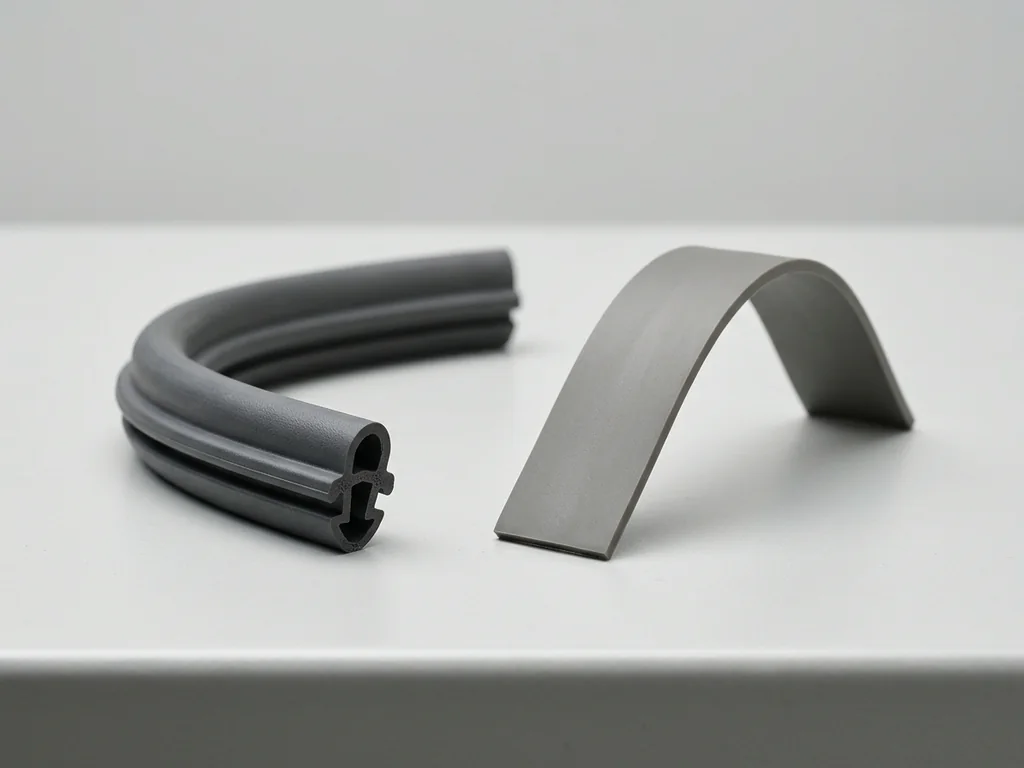
TPE Reference
Tensile: 5–25 MPa; density: 1.05 g/cm³.
Thermoplastic-elastomer injection-grade reference; hardness, grade and interface compatibility require review, no universal 2K claim.
Hardness: Shore 0A–90A (typically 30A–75A).
Typical uses: Soft-touch handles and grips, seals and gaskets, medical devices and catheters, wearable-device straps, automotive weatherstripping and floor mats, toothbrush-handle overmoulding
Characteristics: Rubber-like flexibility, processable as a thermoplastic; hardness varies with grade.
Source handbook cost tier: $$ across its material table; not a within-family ranking or a quote.
Process references (confirm for the project): two-shot/overmoulding (secondary injection bonding with ABS/PC/PP); Injection moulding (highest efficiency);two-shot/overmoulding (secondary injection bonding with ABS/PC/PP); extrusion
Material limitations: Low temperature resistance (generally <120 °C); creeps under sustained compression; some grades require drying; raw-material cost higher than commodity plastics
Sheet Material References
5052 Aluminum
Tensile: 228 MPa; density: 2.68 g/cm³.
H32 / H34 (strain hardening + stabilising); confirm exact supplier grade, state and test data.
Hardness: 60 HB.
Typical uses: Marine sheet metal and cabins, automotive fuel tanks, electronics enclosures, pressure vessels, aircraft oil lines, nameplates, lamp housings
Features: Corrosion Resistance Fatigue Resistance
Relative cost within Aluminum Alloys: ★☆☆☆☆ (source tier $; ordinal reference, not a quote).
Process references (confirm for the project): CNC milling, turning; Sheet metal laser cutting, bending, stamping (best bending properties); MIG/TIG welding;riveting
Material limitations: Non-heat-treatable, medium strength; slightly gummy when machining, surface prone to scratching
C27400 Brass Reference
Tensile: 340–470 MPa; density: 8.47 g/cm³.
Annealed O / Cold-drawn H; confirm exact supplier grade, state and test data.
Hardness: 55–80 HB.
Typical uses: Cartridge cases and ammunition, radiator cores, fittings and connectors, decorative hardware, electrical parts, stamped deep-drawn parts
Features: Corrosion Resistance Ductility
Source handbook cost tier: $$$ across its material table; not a within-family ranking or a quote.
Process references (confirm for the project): CNC turning, milling, drilling (good machinability); sheet-metal stamping, deep drawing, spinning; brazing / soldering
Material limitations: Machinability inferior to leaded brass (C36000); dezincification risk (select corrosion-resistant grade / add As); sensitive to stress cracking
C11000 Copper
Tensile: 220–400 MPa; density: 8.89 g/cm³.
Annealed O / Drawn H (most common); confirm exact supplier grade, state and test data.
Hardness: 65–90 HB.
Typical uses: Wire, cable and busbars, heat sinks and heat exchangers, terminals and connectors, architectural decoration, piping and fittings, cookware
Features: Ductility Electrical Conductivity
Relative cost within Copper: ★☆☆☆☆ (source tier $$$; ordinal reference, not a quote).
Process references (confirm for the project): CNC milling, turning, drilling (machinability better than oxygen-free copper); sheet-metal stamping, bending, pipe bending; soldering / brazing
Material limitations: Low strength, soft, easily scratched; built-up edge in cutting; hydrogen embrittlement under high-temperature reducing atmosphere; high density
Source note: Source title and cross-reference include C110 and TU0; verify alloy and cross-standard labels before publishing exact correspondence.
SPCC/DC01 Sheet Entry
Tensile: 270–410 MPa; density: 7.85 g/cm³.
Cold-rolled annealed (CR / CA); confirm exact supplier grade, state and test data.
Hardness: 100–150 HB.
Typical uses: Electronic equipment enclosures and panels, appliance housings, automotive outer panels, office furniture, hardware stampings, metal enclosures
Characteristics: Smooth sheet surface with good stamping, deep-drawing and welding characteristics.
Source handbook cost tier: $ across its material table; not a within-family ranking or a quote.
Process references (confirm for the project): CNC drilling and tapping; Sheet metal laser cutting, stamping, bending, deep drawing (excellent formability); spot welding
Material limitations: Low strength, non-heat-treatable; rusts easily without protection; limited thick-plate availability
SUS304 Stainless Steel
Tensile: 505–700 MPa; density: 7.93 g/cm³.
Solution annealed, 2B / BA / No.1 / No.4; confirm exact supplier grade, state and test data.
Hardness: 170–220 HB.
Typical uses: Chemical and food equipment, pressure vessels, medical instruments, architectural decoration, household kitchen and bath, sheet-metal enclosures, fasteners
Features: Corrosion Resistance
Relative cost within Stainless Steel: ★☆☆☆☆ (source tier $$; ordinal reference, not a quote).
Process references (confirm for the project): CNC milling, turning, drilling, tapping (use low speed and high feed, avoid work hardening); grinding; sheet metal laser cutting, bending, stamping, roll bending; TIG/MIG/laser welding
Material limitations: Poor machinability (built-up edge + work hardening); prone to pitting and stress corrosion in chloride environments; no Mo, poor seawater resistance
Printing Polymer and Resin References

SLA Rubber-Like Resin Reference
Shore 70A–80A hardness reference for rubber-like SLA resin.
Seal/grip validation resin, not a long-term elastomer. Confirm the named resin, cure and supplier test conditions; not bulk ABS.
Hardness: Formlabs Flexible 80A V1 example: 80 Shore A after post-curing; resin formulation and curing affect hardness.
Typical uses: flexible prototypes, seals, gaskets and soft-touch parts; choose a formulation for the application.
Characteristics: rubber-like flexibility and repeated bending or compression; performance varies by resin and cure.
Cost factors: resin formulation, print volume, support removal and post-curing; request a project-specific quote.

SLS PA2200 / PA12 Reference
EOS PA 2200 Balance dry tensile values: 48 MPa (XY), 42 MPa (Z), ISO 527; orientation and conditioning affect results.
As-built polymer powder-bed reference;powder blend and orientation affect properties. Supply arrangements require separate review.
Hardness: EOS PA 2200 Balance example: 75 Shore D in X orientation, dry, ISO 7619-1; values vary with process and conditioning.
Typical uses: functional prototypes and parts with hinges or threads.
Characteristics: PA12 powder-bed material suited to functional prototypes; printed properties vary with orientation and moisture.
Cost factors: powder grade, part geometry, nesting, build volume and finishing; request a project-specific quote.
Metal Powder-Bed Method References

SLM AlSi10Mg Reference
Renishaw AM250 400 W as-built tensile values: 442 ± 6 MPa (XY) and 417 ± 27 MPa (Z); stress relief and build settings change results.
Metal LPBF industry reference;confirm grade, stress relief and finished-part tests. No owned SLM equipment or current supply is established.
Hardness: Renishaw AM250 400 W as-built AlSi10Mg example: 119 ± 5 HV0.5 (XY), 123 ± 2 HV0.5 (Z); post-processing changes values.
Typical uses: lightweight components, consumer goods and electronics cooling parts.
Characteristics: low density, high specific strength and thermal conductivity; validate design and process.
Cost factors: alloy powder, build orientation, supports, heat treatment and finishing; request a project-specific quote.

SLM 316L Reference
Tensile: 550–650 MPa for the stress-relieved 316L SLM reference.
Stress-relieved metal LPBF reference, not a wrought-stainless substitution. Confirm the supply arrangements, condition and required inspection separately.
Hardness: Renishaw AM250 as-built 316L example: 198 ± 8 HV0.5 (XY), 208 ± 6 HV0.5 (Z); printed properties depend on process and direction.
Typical uses: tooling, maritime components and general engineering parts.
Features: Corrosion Resistance Toughness and polishability depend on the process and service environment.
Cost factors: powder grade, build orientation, supports, heat treatment and finishing; request a project-specific quote.
Additional material references
Aluminum Alloys
Aluminum 1100 (Commercially Pure)
Yield: 35–105 MPa; Tensile: 90–130 MPa; Density: 2.71 g/cm³.
Typical condition: O / H14 (non-heat-treatable). Confirm the grade, supplier data and test conditions for each order.
Hardness: 23–32 HB.
Typical uses: Chemical tanks and piping, sheet-metal enclosures, heat sinks and heat exchangers, nameplates, cookware, busbars, lamp reflectors
Features: Corrosion Resistance Electrical Conductivity Cost Effective
Relative cost within Aluminum Alloys: ★☆☆☆☆ (source tier $; ordinal reference, not a quote).
Process references (confirm for the project): CNC milling, turning, drilling; sheet metal laser cutting, bending, stamping, roll bending, deep drawing; MIG/TIG welding;brazing
Material limitations: Lowest strength among common aluminums; non-heat-treatable; soft material prone to scratching, built-up edge/gumming during machining
Aluminum 2024 (Duralumin)
Yield: 325 MPa; Tensile: 470 MPa; Density: 2.78 g/cm³.
Typical condition: T3 / T351 (heat-treatable). Confirm the grade, supplier data and test conditions for each order.
Hardness: 120 HB.
Typical uses: Aircraft skins and structural parts, stringers, wing ribs, truck wheels, aerospace structures, military parts, high-fatigue-load components
Features: Fatigue Resistance
Relative cost within Aluminum Alloys: ★★★★★ (source tier $$; ordinal reference, not a quote).
Process references (confirm for the project): CNC milling, turning; drilling, reaming; sheet metal forming (annealed condition); mainly riveting (poor fusion weldability)
Material limitations: Poor corrosion resistance (Alclad or anodising/painting mandatory); poor fusion weldability, prone to hot cracking; higher cost than 6xxx
Process conditions or limitations: Welding and Assembly: mainly riveting (poor fusion weldability)
Aluminum 3003 (Corrosion-Resistant)
Yield: 40–115 MPa; Tensile: 110–150 MPa; Density: 2.73 g/cm³.
Typical condition: O / H14 (non-heat-treatable). Confirm the grade, supplier data and test conditions for each order.
Hardness: 40 HB.
Typical uses: Sheet-metal enclosures and housings, fuel tanks and vessels, heat exchangers, cookware, roofing and curtain walls, chemical containers, nameplates
Features: Corrosion Resistance Cost Effective
Relative cost within Aluminum Alloys: ★☆☆☆☆ (source tier $; ordinal reference, not a quote).
Process references (confirm for the project): CNC milling, turning; Sheet metal laser cutting, bending, stamping, spinning; MIG/TIG welding;brazing
Material limitations: Non-heat-treatable, relatively low strength; moderate machinability (somewhat gummy)
Aluminum 5083 (High Magnesium)
Yield: 275 MPa; Tensile: 305 MPa; Density: 2.66 g/cm³.
Typical condition: H116 / H321 (exfoliation-corrosion-resistant condition). Confirm the grade, supplier data and test conditions for each order.
Hardness: 75 HB.
Typical uses: LNG storage tanks and cryogenic vessels, ship decks and hulls, pressure tanks, armour plate, drilling rig platforms, rail transit car bodies
Features: Corrosion Resistance
Relative cost within Aluminum Alloys: ★☆☆☆☆ (source tier $; ordinal reference, not a quote).
Process references (confirm for the project): CNC milling, turning; Sheet metal laser cutting, bending, roll bending; MIG/TIG welding (filler 5183/5356)
Material limitations: Non-heat-treatable; high Mg content is sensitisation-sensitive (choose H116/H321); pronounced work hardening
Aluminum 5754 (Al-Mg Alloy)
Yield: 190 MPa; Tensile: 240 MPa; Density: 2.67 g/cm³.
Typical condition: H22 / H111 (strain hardened). Confirm the grade, supplier data and test conditions for each order.
Hardness: 63 HB.
Typical uses: Automotive door panels and floor panels, marine superstructures, welded structures, vessels, sheet-metal bent parts, ship decks
Features: Corrosion Resistance
Relative cost within Aluminum Alloys: ★☆☆☆☆ (source tier $; ordinal reference, not a quote).
Process references (confirm for the project): CNC milling; Sheet metal laser cutting, bending, stamping, roll bending; MIG/TIG welding
Material limitations: Non-heat-treatable, medium strength; springback to watch for when bending thick plate
Aluminum 6063 (Architectural)
Yield: 214 MPa; Tensile: 241 MPa; Density: 2.70 g/cm³.
Typical condition: T5 / T6 (ageing after extrusion). Confirm the grade, supplier data and test conditions for each order.
Hardness: 73 HB.
Typical uses: Window/door and curtain-wall profiles, heat sinks and LED housings, irrigation pipe, decorative trims, furniture tubing, display racks, PV frames
Characteristics: Good extrudability, anodizing response and thermal conductivity.
Relative cost within Aluminum Alloys: ★☆☆☆☆ (source tier $; ordinal reference, not a quote).
Process references (confirm for the project): CNC milling, drilling; MIG/TIG welding; Extrusion (best extrudability)
Material limitations: Medium strength; wall-thickness quenching sensitivity; not suitable for load-bearing structures
Aluminum 6082 (High Strength)
Yield: 260 MPa; Tensile: 310 MPa; Density: 2.70 g/cm³.
Typical condition: T6 / T651. Confirm the grade, supplier data and test conditions for each order.
Hardness: 95 HB.
Typical uses: Bridges and walkways, crane arms and hoists, trusses, marine structures and gangways, building load-bearing parts, mould plates
Characteristics: High strength within 6xxx alloys, with good machinability and weldability.
Relative cost within Aluminum Alloys: ★☆☆☆☆ (source tier $; ordinal reference, not a quote).
Process references (confirm for the project): CNC milling, turning, drilling; stamping (limited); MIG/TIG welding
Material limitations: Poor extrudability, difficult complex sections; thick-section quenching sensitivity causes core strength drop
Aluminum 7075 (Ultra-High Strength)
Yield: 503 MPa; Tensile: 572 MPa; Density: 2.81 g/cm³.
Typical condition: T6 / T651 / T73. Confirm the grade, supplier data and test conditions for each order.
Hardness: 150 HB.
Typical uses: Aircraft structural parts and fuselage frames, gears and shafts, climbing equipment, high-performance automotive parts, moulds and tooling, military and optical sights
Features: Dimensional Stability Fatigue Resistance
Relative cost within Aluminum Alloys: ★★★★★ (source tier $$; ordinal reference, not a quote).
Process references (confirm for the project): CNC milling, turning (excellent machinability, good chip breaking); drilling, reaming; grinding; mainly riveting (very poor fusion weldability)
Material limitations: Poor corrosion resistance (anodising/Alclad required); stress-corrosion cracking sensitive (T73 for critical parts); not fusion weldable; high cost
Process conditions or limitations: Welding and Assembly: mainly riveting (very poor fusion weldability)
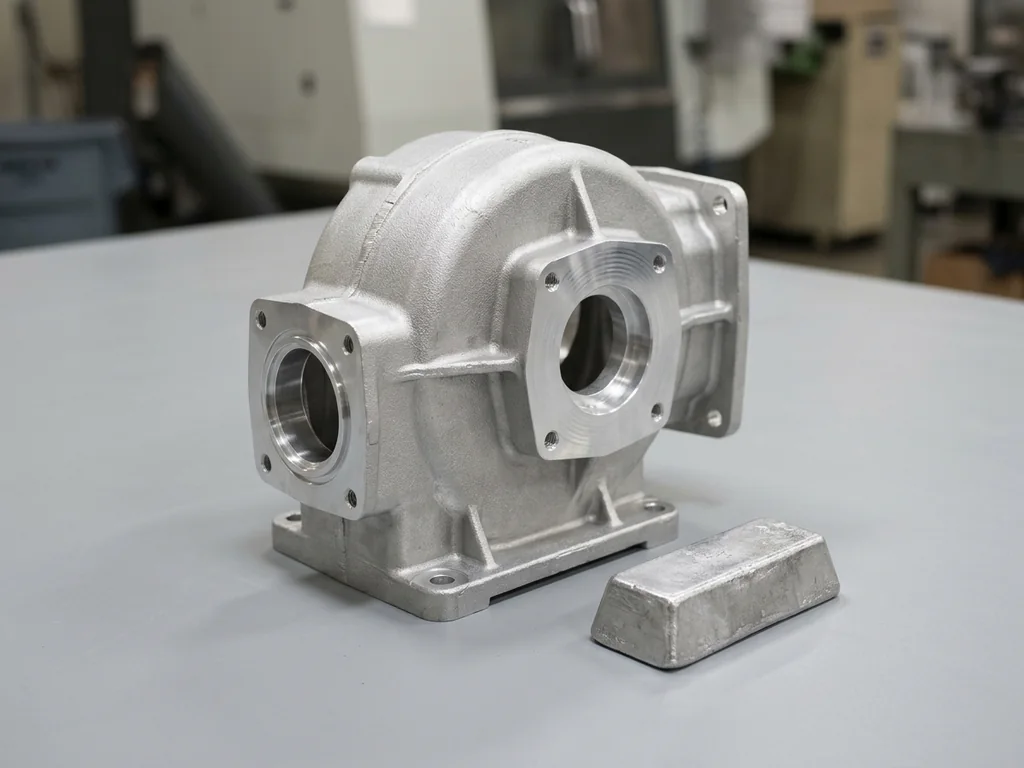
Aluminum ADC12 (Die Casting)
Yield: 160 MPa; Tensile: 310 MPa; Density: 2.74 g/cm³.
Typical condition: F (as-cast, generally non-solution-strengthenable). Confirm the grade, supplier data and test conditions for each order.
Hardness: 80 HB.
Typical uses: Automotive transmission/engine housings, electronics and telecommunications equipment housings, motor end covers, industrial machinery housings, lamp heat-sink housings
Features: Dimensional Stability
Relative cost within Aluminum Alloys: ★☆☆☆☆ (source tier $; ordinal reference, not a quote).
Process references (confirm for the project): CNC milling, drilling, tapping (secondary finishing); High-pressure die casting (primary)
Material limitations: Low elongation (approx. 3.5%), brittle; internal porosity prevents fusion welding and heat-treatment strengthening; poor anodised appearance
Stainless Steel
Stainless Steel SUS201 (Manganese Series)
Yield: 275–380 MPa; Tensile: 520–750 MPa; Density: 7.90 g/cm³.
Typical condition: Solution annealed / 2B, BA, No.4. Confirm the grade, supplier data and test conditions for each order.
Hardness: 147–217 HB.
Typical uses: Kitchenware and sinks, appliance housings and panels, cutlery, architectural decoration, indoor handrails, tableware and cookware
Features: Cost Effective
Relative cost within Stainless Steel: ★☆☆☆☆ (source tier $$; ordinal reference, not a quote).
Process references (confirm for the project): CNC milling, turning, drilling, tapping (use low speed and high feed, avoid work hardening); grinding; sheet metal laser cutting, bending, stamping, roll bending; TIG/MIG/laser welding
Material limitations: Corrosion resistance markedly lower than 304; prone to rusting in humid/chloride environments; weld sensitisation risk; intermediate annealing required for deep drawing
Stainless Steel SUS301 (High Work-Hardening)
Yield: 205–965 MPa; Tensile: 515–1275 MPa; Density: 7.90 g/cm³.
Typical condition: 1/4H, 1/2H, 3/4H, FH (cold-rolled hardened). Confirm the grade, supplier data and test conditions for each order.
Hardness: 150–400 HB.
Typical uses: Spring strips and clips, clamps and buckles, rail vehicle bodies, stamped structural parts, fasteners, knives and shears
Characteristics: High work-hardening rate; cold work can increase strength.
Relative cost within Stainless Steel: ★☆☆☆☆ (source tier $$; ordinal reference, not a quote).
Process references (confirm for the project): CNC milling; Sheet metal stamping, bending, roll forming; Sheet metal stamping, bending, roll forming;spring strip blanking; spot/laser welding
Material limitations: Reduced formability and weldability in high-hardness tempers; corrosion resistance lower than 304/316; difficult to achieve uniform work hardening in thick plate
Stainless Steel SUS303 (Free-Cutting)
Yield: 415–450 MPa; Tensile: 620–690 MPa; Density: 7.90 g/cm³.
Typical condition: Solution annealed (mainly bar stock). Confirm the grade, supplier data and test conditions for each order.
Hardness: 190–240 HB.
Typical uses: Screws/nuts/bolts, gears, shafts, bushings, valve parts, automatic-lathe batch parts, fittings
Characteristics: Free-machining austenitic steel with good chip breaking.
Relative cost within Stainless Steel: ★★★☆☆ (source tier $$$; ordinal reference, not a quote).
Process references (confirm for the project): CNC turning, milling, drilling, tapping (preferred for automatic lathes)
Material limitations: Reduced corrosion resistance due to sulphides; not for food/medical/marine use; poor weldability; not suitable for forging or deep drawing
Process conditions or limitations: Stamping and Deep Drawing: not suitable for welding or deep drawing; Welding and Assembly: not suitable for welding or deep drawing
Stainless Steel SUS304L (Low Carbon)
Yield: 170–240 MPa; Tensile: 485–620 MPa; Density: 7.90 g/cm³.
Typical condition: Solution annealed. Confirm the grade, supplier data and test conditions for each order.
Hardness: 140–200 HB.
Typical uses: Welded structures, chemical tanks and piping, nuclear and pharmaceutical equipment, food storage tanks, large welded frames
Features: Corrosion Resistance
Relative cost within Stainless Steel: ★☆☆☆☆ (source tier $$; ordinal reference, not a quote).
Process references (confirm for the project): CNC milling, turning, drilling, tapping (use low speed and high feed, avoid work hardening); grinding; sheet metal laser cutting, bending, stamping, roll bending; TIG/MIG/laser welding
Material limitations: Strength slightly lower than 304; not for high-yield applications; price slightly higher
Stainless Steel SUS316 (Molybdenum-Bearing)
Yield: 170–310 MPa; Tensile: 515–620 MPa; Density: 8.00 g/cm³.
Typical condition: Solution annealed, 2B / BA / No.4. Confirm the grade, supplier data and test conditions for each order.
Hardness: 140–220 HB.
Typical uses: Marine hardware and propeller shafts, chemical tanks and piping, pharmaceutical and food equipment, offshore platforms, heat exchangers, medical implants
Features: Corrosion Resistance
Relative cost within Stainless Steel: ★★★☆☆ (source tier $$$; ordinal reference, not a quote).
Process references (confirm for the project): CNC milling, turning, drilling, tapping (use low speed and high feed, avoid work hardening); grinding; sheet metal laser cutting, bending, stamping, roll bending; TIG/MIG/laser welding
Material limitations: Higher cost; machinability slightly poorer than 303; when Ti/Nb absent, low-carbon grade (316L) still needed for welding thick plate
Stainless Steel SUS316L (Low Carbon, Molybdenum-Bearing)
Solution-annealed reference values; not for printed parts: Yield: 170–290 MPa; Tensile: 485–620 MPa; Density: 7.90 g/cm³.
Typical condition: Solution annealed, 3D printing powder (SLM/DMLS). Confirm the grade, supplier data and test conditions for each order.
Hardness: 140–190 HB (solution-annealed reference; not a printed-part specification).
Typical uses: Pharmaceutical and bioengineering equipment, implants and orthopaedic instruments, marine and chemical equipment, 3D-printed complex flow-channel parts, food-grade containers
Features: Corrosion Resistance
Relative cost within Stainless Steel: ★★★☆☆ (source tier $$$; ordinal reference, not a quote).
Process references (confirm for the project): CNC milling, turning, grinding; sheet metal laser cutting, bending, welding; laser powder bed fusion 3D printing (most mature)
Material limitations: Lower strength; poor wear and galling resistance; higher cost; pronounced work hardening during cutting
Source note: The entry combines annealed wrought and SLM powder conditions: do not transfer wrought hardness/strength to printed parts.
Stainless Steel SUS410 (Martensitic)
Yield: 205–275 MPa; Tensile: 450–520 MPa; Density: 7.75 g/cm³.
Typical condition: Annealed / quench-and-tempered. Confirm the grade, supplier data and test conditions for each order.
Hardness: 150–200 HB (≈35–45 HRC after Q&T).
Typical uses: Valves and valve cores, pump shafts and bushings, fasteners, turbine blades, cutlery and flatware, oilfield machinery parts
Features: Dimensional Stability Cost Effective
Relative cost within Stainless Steel: ★☆☆☆☆ (source tier $$; ordinal reference, not a quote).
Process references (confirm for the project): CNC milling, turning, grinding; sheet metal stamping, bending (annealed condition); welding requires preheat 200–300 °C
Material limitations: Corrosion resistance markedly weaker than 304/316; welding requires preheat and post-heat; poor low-temperature toughness
Stainless Steel SUS420 (Martensitic)
Yield: 345–650 MPa; Tensile: 520–700 MPa; Density: 7.80 g/cm³.
Typical condition: Annealed / quench-and-tempered. Confirm the grade, supplier data and test conditions for each order.
Hardness: 180–290 HB (≈48–52 HRC after Q&T).
Typical uses: Cutting tools and scissors, surgical instruments, valves and valve seats, pump parts, mould inserts, measuring tools
Characteristics: Heat-treatable martensitic steel with good wear resistance after hardening.
Relative cost within Stainless Steel: ★☆☆☆☆ (source tier $$; ordinal reference, not a quote).
Process references (confirm for the project): CNC milling, turning, grinding; CNC milling, turning, grinding;polishing
Material limitations: Moderate corrosion resistance (lower than 304); poor weldability, requires preheat; lower toughness than austenitics, thick parts prone to cracking
Process conditions or limitations: Welding and Assembly: poor weldability (requires preheat 300 °C)
Stainless Steel SUS420C (High-Carbon Martensitic)
Yield: 440 (quenched & tempered) MPa; Tensile: 650–850 MPa; Density: 7.75 g/cm³.
Typical condition: Annealed / quenched + low-temperature tempered. Confirm the grade, supplier data and test conditions for each order.
Hardness: 50–56 HRC (≈500–580 HB).
Typical uses: High-hardness cutting tools and razor blades, surgical blades and dental instruments, gauges and callipers, bearings and bushings, nozzles, plastic moulds
Features: Dimensional Stability
Relative cost within Stainless Steel: ★☆☆☆☆ (source tier $$; ordinal reference, not a quote).
Process references (confirm for the project): CNC milling, turning (recommend rough machining in annealed condition then quenching); grinding;precision polishing;wire EDM
Material limitations: Corrosion resistance inferior to 304/316; very poor weldability; prone to cracking if not adequately tempered; cutting requires machining in annealed condition
Stainless Steel SUS430 (Ferritic)
Yield: 275–450 MPa; Tensile: 450–600 MPa; Density: 7.75 g/cm³.
Typical condition: Annealed, 2B / BA / No.4. Confirm the grade, supplier data and test conditions for each order.
Hardness: 150–200 HB.
Typical uses: Automotive trim and exhaust systems, appliance panels and washing machine tubs, kitchen equipment, building curtain walls, screws and fasteners
Features: Cost Effective
Relative cost within Stainless Steel: ★☆☆☆☆ (source tier $$; ordinal reference, not a quote).
Process references (confirm for the project): CNC turning, milling; Sheet metal laser cutting, bending, stamping, deep drawing; TIG/spot welding (heat control required)
Material limitations: Not heat-treatable for strengthening; poorer toughness and weldability; low-temperature brittleness; rusts in strongly corrosive environments
Stainless Steel SUS431 (High-Strength Martensitic)
Yield: 690–900 MPa; Tensile: 850–1000 MPa; Density: 7.75 g/cm³.
Typical condition: Quenched + high-temperature tempered (Q&T). Confirm the grade, supplier data and test conditions for each order.
Hardness: 248–293 HB (≈25–32 HRC).
Typical uses: Aircraft and marine shafts, pump shafts and piston rods, high-strength bolts and connecting rods, valve stems, chemical corrosion-resistant load-bearing parts
Features: Corrosion Resistance
Relative cost within Stainless Steel: ★★★☆☆ (source tier $$$; ordinal reference, not a quote).
Process references (confirm for the project): CNC milling, turning (high hardness, carbide tooling required); grinding;polishing
Material limitations: Relatively difficult to machine, high tooling cost; strict tempering required to avoid embrittlement range; poor weldability
Process conditions or limitations: Welding and Assembly: limited weldability
Stainless Steel SUS440C (High-Carbon Martensitic)
Yield: 450–1900 MPa; Tensile: 760–1970 MPa; Density: 7.75 g/cm³.
Typical condition: Annealed / quenched + low-temperature tempered. Confirm the grade, supplier data and test conditions for each order.
Hardness: 58–62 HRC (≈285–600 HB).
Typical uses: Bearings and bearing rings, surgical instruments and dental burs, gauges and gauge blocks, cutting tools and edges, nozzles, valve balls, mould inserts
Features: Dimensional Stability
Relative cost within Stainless Steel: ★★★☆☆ (source tier $$$; ordinal reference, not a quote).
Process references (confirm for the project): CNC milling, turning (recommend rough machining in spheroidised-annealed condition → quenching → grinding finish); CNC milling, turning (recommend rough machining in spheroidised-annealed condition → quenching → grinding finish);grinding;wire EDM;polishing
Material limitations: Low toughness, prone to chipping; moderate corrosion resistance (lower than 304); difficult cutting and grinding; must be soft-annealed before machining
Stainless Steel SUS630 / 17-4PH (Precipitation Hardening)
Yield: 725–1170 MPa; Tensile: 930–1310 MPa; Density: 7.80 g/cm³.
Typical condition: Solution condition A / H900, H1025, H1075, H1150 aged. Confirm the grade, supplier data and test conditions for each order.
Hardness: 28–42 HRC (≈248–388 HB).
Typical uses: Gas turbine and turbine blades, chemical and petroleum equipment, aircraft structural parts, pumps, valves and shafts, medical instruments, plastic moulds, 3D-printed parts
Features: Corrosion Resistance
Relative cost within Stainless Steel: ★★★★★ (source tier $$$$; ordinal reference, not a quote).
Process references (confirm for the project): CNC milling, turning (rough machining in solution condition → ageing → finish machining/grinding); sheet metal laser cutting, bending; welding (re-ageing required after welding)
Material limitations: High cost; pronounced machining work hardening requires optimised parameters; rough machining must be completed before ageing; limited low-temperature toughness
Steel (Structural)
Structural Steel Q235 / A36
Yield: 235 MPa; Tensile: 370–500 MPa; Density: 7.85 g/cm³.
Typical condition: Hot-rolled (HR). Confirm the grade, supplier data and test conditions for each order.
Hardness: 120–160 HB.
Typical uses: Buildings and steel structures, frames and bases, bridges and ships, equipment enclosures, welded frames, general sheet metal parts
Features: Cost Effective
Source handbook cost tier: $ across its material table; not a within-family ranking or a quote.
Process references (confirm for the project): CNC milling (soft, average surface finish); Sheet metal laser/plasma/flame cutting, bending, stamping, drilling; welding (excellent weldability)
Material limitations: Low strength, poor corrosion resistance (painting required); average surface quality and dimensional accuracy; non-heat-treatable
Steel (Galvanised Sheet)

Hot-Dip Galvanised Sheet SGCC
Yield: 140–280 MPa; Tensile: 270–420 MPa; Density: 7.85 g/cm³.
Typical condition: Hot-dip galvanised (Z100–Z275). Confirm the grade, supplier data and test conditions for each order.
Hardness: 100–140 HB.
Typical uses: Electrical control cabinets and distribution boxes, ventilation ducts and HVAC, building roofing and wall panels, cabinet enclosures, automotive inner panels
Characteristics: Zinc coating provides sacrificial corrosion protection to the steel substrate.
Source handbook cost tier: $ across its material table; not a within-family ranking or a quote.
Process references (confirm for the project): Sheet metal laser cutting, bending, stamping, roll forming; spot welding (parameters need adjustment)
Material limitations: Welding fume is toxic and requires ventilation; zinc coating fails when heated above 200 °C; cut edges and welds still rust; laser cutting zinc vapour affects quality

Electro-Galvanised Sheet SECC
Yield: 140–280 MPa; Tensile: 270–410 MPa; Density: 7.85 g/cm³.
Typical condition: Electro-galvanised (thin and uniform zinc coating). Confirm the grade, supplier data and test conditions for each order.
Hardness: 100–140 HB.
Typical uses: Computer and server enclosures, appliance inner panels, precision electronic housings, office equipment, instrument cases, parts requiring painted appearance
Characteristics: Electroplated zinc coating gives a uniform finish suitable for painting.
Source handbook cost tier: $ across its material table; not a within-family ranking or a quote.
Process references (confirm for the project): Sheet metal stamping, bending, laser cutting; Sheet metal stamping, bending, laser cutting;precision stamping; spot welding (better than hot-dip galvanised)
Material limitations: Thin zinc coating, weaker corrosion resistance than hot-dip galvanised; not suitable for outdoor exposed use; higher cost than cold-rolled sheet
Steel (Carbon)
Carbon Steel 1018 (Low Carbon)
Yield: 370 MPa; Tensile: 440 MPa; Density: 7.87 g/cm³.
Typical condition: Cold-rolled / hot-rolled. Confirm the grade, supplier data and test conditions for each order.
Hardness: 126–180 HB.
Typical uses: Shafts and pins, gears (carburised), bolts and fasteners, bushings, fixtures and jigs, frame parts, welded structures
Features: Cost Effective
Source handbook cost tier: $ across its material table; not a within-family ranking or a quote.
Process references (confirm for the project): CNC turning, milling, drilling, tapping (good machinability); grinding; sheet metal bending; welding (excellent weldability)
Material limitations: Low overall strength, cannot be through-hardened by quenching; poor corrosion resistance requires surface protection; low hardenability
Carbon Steel 1020 (Low Carbon)
Yield: 350 MPa; Tensile: 420 MPa; Density: 7.87 g/cm³.
Typical condition: Hot-rolled / cold-drawn. Confirm the grade, supplier data and test conditions for each order.
Hardness: 111–170 HB.
Typical uses: General machine parts, shaft sleeves and pins, welded structural parts, carburised gears and cams, agricultural machinery parts, mould base plates
Features: Cost Effective
Source handbook cost tier: $ across its material table; not a within-family ranking or a quote.
Process references (confirm for the project): CNC turning, milling, drilling; sheet metal stamping, bending; welding (excellent weldability)
Material limitations: Limited overall strength, poor corrosion resistance; low hardenability, large sections cannot be through-hardened
Carbon Steel 1025 (Medium-Low Carbon)
Yield: 380 MPa; Tensile: 460 MPa; Density: 7.87 g/cm³.
Typical condition: Hot-rolled / normalised. Confirm the grade, supplier data and test conditions for each order.
Hardness: 120–180 HB.
Typical uses: Shafts and connecting rods, bolts, forged parts, gears, agricultural and general machinery parts
Characteristics: Strength, ductility and weldability are balanced for general-purpose parts.
Source handbook cost tier: $ across its material table; not a within-family ranking or a quote.
Process references (confirm for the project): CNC turning, milling, drilling; welding (preheating preferred); forging
Material limitations: Poor corrosion resistance; hardenability still low; thick-plate welding requires preheating
Steel (Free-Cutting)
Free-Cutting Steel 1215
Yield: 415 MPa; Tensile: 540 MPa; Density: 7.87 g/cm³.
Typical condition: Cold-drawn. Confirm the grade, supplier data and test conditions for each order.
Hardness: 167–217 HB.
Typical uses: Bolts and studs, fittings and pipe parts, batch shaft parts on automatic lathes, instrument parts, hydraulic fittings
Characteristics: Free-cutting steel with good chip breaking and machinability.
Source handbook cost tier: $ across its material table; not a within-family ranking or a quote.
Process references (confirm for the project): High-speed turning on automatic lathes, drilling, tapping (excellent machinability)
Material limitations: Cannot be welded, low toughness, not suitable for impact loads; poor corrosion resistance; moderate strength
Process conditions or limitations: Welding and Assembly: not suitable for welding and forging; Forging: not suitable for welding and forging
Steel (Alloy)
Alloy Steel 5140 / 40Cr
Yield: 540–785 MPa; Tensile: 785–980 MPa; Density: 7.85 g/cm³.
Typical condition: Annealed / Quenched & tempered (Q&T). Confirm the grade, supplier data and test conditions for each order.
Hardness: 207–250 HB (≈28–35 HRC after Q&T).
Typical uses: Gears and transmission shafts, connecting rods, bolts and high-strength fasteners, worm shafts, die guide pillars, automotive and machine-tool parts
Characteristics: Good strength and toughness after quenching and tempering; surface hardening is possible.
Relative cost within Steel (Alloy): ★☆☆☆☆ (source tier $$; ordinal reference, not a quote).
Process references (confirm for the project): CNC turning, milling, grinding; welding (preheating 200–300 °C required); forging
Material limitations: Fair weldability, preheating required; temper-embrittlement tendency (rapid cooling after tempering); corrosion resistance still needs surface treatment
Chromium-Molybdenum Steel 4140 / 42CrMo
Yield: 655–950 MPa; Tensile: 950–1150 MPa; Density: 7.85 g/cm³.
Typical condition: Annealed / Quenched & tempered (Q&T) / Pre-hardened. Confirm the grade, supplier data and test conditions for each order.
Hardness: 197–280 HB (≈28–40 HRC after Q&T).
Typical uses: High-strength shafts and gears, crankshafts and connecting rods, oil-drilling tools, die bases and cores, high-strength bolts, aerospace and racing parts
Characteristics: Heat-treatable alloy steel with good strength, toughness and hardenability.
Relative cost within Steel (Alloy): ★☆☆☆☆ (source tier $$; ordinal reference, not a quote).
Process references (confirm for the project): CNC turning, milling, drilling, grinding; welding (preheat 250–350 °C + post-weld temper); forging
Material limitations: Poor weldability (preheat + post-weld temper mandatory); high cost; machining best in annealed or pre-hardened state
Chromium-Molybdenum Steel 4130
Yield: 460–700 MPa; Tensile: 670–950 MPa; Density: 7.85 g/cm³.
Typical condition: Normalised / Quenched & tempered / Seamless tube stock. Confirm the grade, supplier data and test conditions for each order.
Hardness: 156–250 HB.
Typical uses: Aerospace and racing tube frames (roll cage), bicycle frames, oil & gas pipelines, pressure vessels, shafts and gears, dies
Characteristics: Good strength-to-weight ratio and weldability; heat-treatable.
Relative cost within Steel (Alloy): ★☆☆☆☆ (source tier $$; ordinal reference, not a quote).
Process references (confirm for the project): CNC turning, milling; grinding; sheet-metal bending and tube bending (good for welded tubing); sheet-metal bending and tube bending (good for welded tubing);TIG/MIG welding (better than 4140)
Material limitations: Lower strength than 4140; poor corrosion resistance, coating required; sensitive to heat-treatment parameters
Nickel Chromium-Molybdenum Steel 4340
Yield: 710–980 MPa; Tensile: 980–1250 MPa; Density: 7.85 g/cm³.
Typical condition: Annealed / Quenched & tempered (Q&T). Confirm the grade, supplier data and test conditions for each order.
Hardness: 217–300 HB (≈30–40 HRC after Q&T).
Typical uses: Aircraft landing gear and structural members, crankshafts and gears, heavy-load shafts, military and racing drivetrain parts, large forgings
Features: Fatigue Resistance
Relative cost within Steel (Alloy): ★★★★★ (source tier $$$; ordinal reference, not a quote).
Process references (confirm for the project): CNC turning, milling, grinding (carbide tooling needed in Q&T state); forging
Material limitations: High cost; very poor weldability; pronounced work hardening during cutting; temper embrittlement must be watched (rapid cooling after tempering)
Process conditions or limitations: Welding and Assembly: poor weldability (strict preheating required)
Steel (Spring)
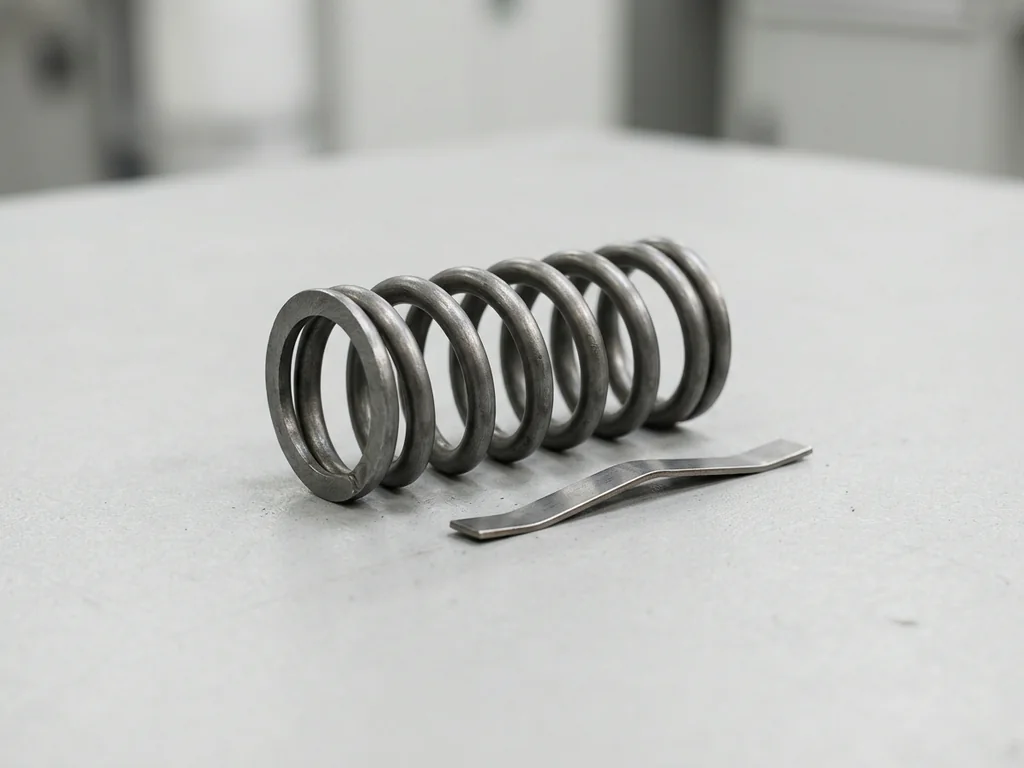
Spring Steel 65Mn
Yield: 800–1100 MPa; Tensile: 1000–1300 MPa; Density: 7.85 g/cm³.
Typical condition: Annealed / Quenched & medium-temperature tempered. Confirm the grade, supplier data and test conditions for each order.
Hardness: 42–48 HRC (≈390–460 HB).
Typical uses: Spring leaves and disc springs, circlips and retaining rings, clutch plates, saw blades and cutting blades, agricultural wear parts, fixture springs
Features: Cost Effective
Source handbook cost tier: $ across its material table; not a within-family ranking or a quote.
Process references (confirm for the project): CNC milling (annealed); grinding; Stamping/form (annealed) → quench & temper
Material limitations: Sensitive to overheating (grain coarsening); strong decarburisation tendency; temper embrittlement; poor corrosion resistance, coating required
Silicon-Manganese Spring Steel 9260
Yield: 1100–1400 MPa; Tensile: 1300–1600 MPa; Density: 7.85 g/cm³.
Typical condition: Hot-rolled annealed / Quenched & medium-temperature tempered. Confirm the grade, supplier data and test conditions for each order.
Hardness: 45–50 HRC (≈420–480 HB).
Typical uses: Automotive suspension coil and leaf springs, torsion bars, clutch springs, railway and construction-machinery large springs, stabiliser bars
Features: Fatigue Resistance
Source handbook cost tier: $$ across its material table; not a within-family ranking or a quote.
Process references (confirm for the project): CNC turning (annealed); grinding; Hot coiling → quench & temper
Material limitations: Decarburisation-sensitive (protective-atmosphere heating required); poor weldability; high Si prone to graphitisation; higher cost than 65Mn
Steel (Tool)
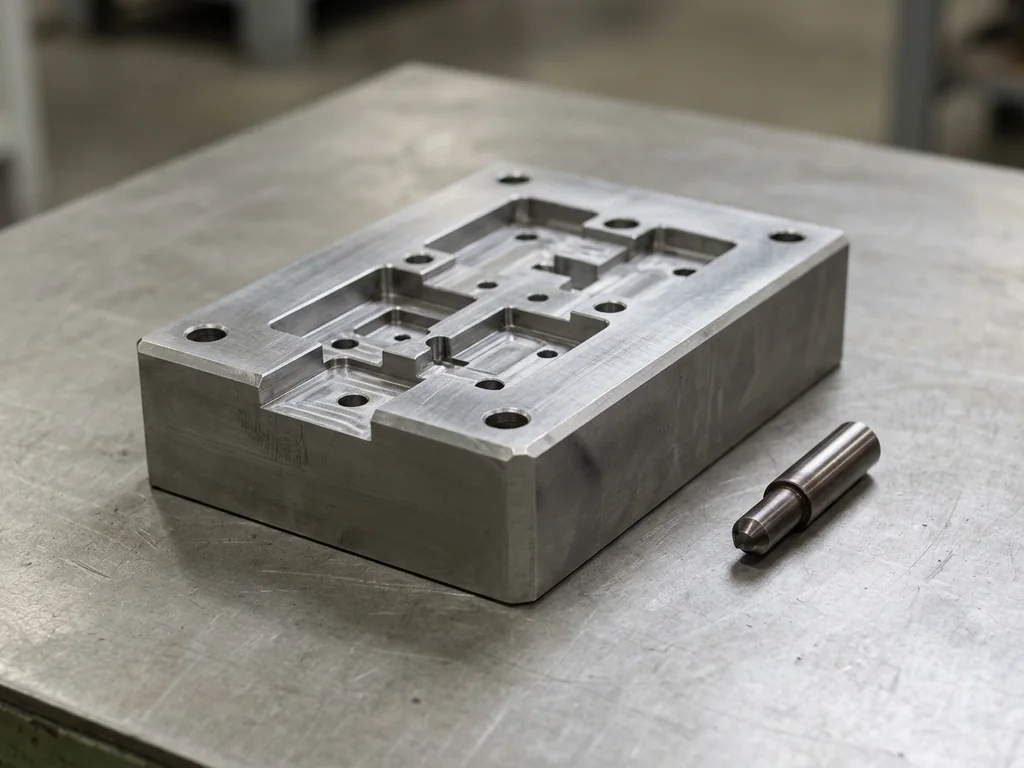
Air-Hardening Die Steel A2
Tensile: After Q&T: 1900–2100 (mainly in compression) MPa; Density: 7.75 g/cm³.
Typical condition: Spheroidised annealed (≈210 HB). Confirm the grade, supplier data and test conditions for each order.
Hardness: 58–62 HRC.
Typical uses: Cold-stamping dies and punches, shear blades and hobbing cutters, forming dies, gauges, fixtures and wear parts, precision blanking dies
Features: Dimensional Stability
Source handbook cost tier: $$$ across its material table; not a within-family ranking or a quote.
Process references (confirm for the project): CNC milling, turning (rough machining in annealed state → hardening → grinding/wire EDM finish); CNC milling, turning (rough machining in annealed state → hardening → grinding/wire EDM finish);grinding;wire EDM
Material limitations: Wear resistance lower than D2; only fair machinability in annealed state; protective atmosphere needed to prevent decarburisation
High-Carbon High-Chromium Steel D2 / SKD11
Tensile: After Q&T: 1700–2100 MPa; Density: 7.70 g/cm³.
Typical condition: Spheroidised annealed (≈220–255 HB). Confirm the grade, supplier data and test conditions for each order.
Hardness: 58–62 HRC (≈600–680 HB).
Typical uses: Cold-stamping and blanking dies, shear blades, thread-rolling dies, drawing dies, gauges, high-precision wear parts, powder-metallurgy dies
Features: Dimensional Stability
Source handbook cost tier: $$$ across its material table; not a within-family ranking or a quote.
Process references (confirm for the project): CNC milling (rough machining in annealed state → hardening → grinding); CNC milling (rough machining in annealed state → hardening → grinding);precision grinding;wire EDM (slow-feed);EDM
Material limitations: Lower toughness, prone to edge chipping; difficult machining in annealed state (high abrasiveness); extremely poor weldability; high cost
Shock-Resisting Tool Steel S7
Yield: 1500–1800 MPa; Tensile: 1900–2100 MPa; Density: 7.80 g/cm³.
Typical condition: Spheroidised annealed (≈200 HB). Confirm the grade, supplier data and test conditions for each order.
Hardness: 55–58 HRC.
Typical uses: Chisels and punches, shear blades, hot/cold forging dies, pneumatic tools, impact-loaded dies and tooling
Characteristics: Shock-resistant tool steel combines toughness and hardness after heat treatment.
Source handbook cost tier: $$$ across its material table; not a within-family ranking or a quote.
Process references (confirm for the project): CNC milling, turning (annealed); grinding;wire EDM; forging
Material limitations: Wear resistance lower than D2; only fair machinability in annealed state; limited high-temperature service
Hot-Work Die Steel SKD61 / H13
Yield: 1380–1650 MPa; Tensile: 1590–1990 MPa; Density: 7.80 g/cm³.
Typical condition: Spheroidised annealed (≈200 HB). Confirm the grade, supplier data and test conditions for each order.
Hardness: 44–52 HRC.
Typical uses: Die-casting dies (aluminium/magnesium/zinc), hot-extrusion dies, hot-forging dies, plastics moulds (high-gloss requirement), hot shear blades
Features: Dimensional Stability
Source handbook cost tier: $$$ across its material table; not a within-family ranking or a quote.
Process references (confirm for the project): CNC milling, turning (rough machining in annealed state → hardening & tempering → grinding/EDM); CNC milling, turning (rough machining in annealed state → hardening & tempering → grinding/EDM);EDM;polishing (up to mirror)
Material limitations: Annealed-state machining needs low speed and high feed; sensitive to heat-treatment process; high cost; room-temperature wear resistance inferior to D2
Steel (High-Speed)

High-Speed Steel SKH51 / M2
Tensile: After Q&T: 2500–3000 (bending 3500–4500) MPa; Density: 8.15 g/cm³.
Typical condition: Spheroidised annealed (≈240–260 HB). Confirm the grade, supplier data and test conditions for each order.
Hardness: 63–66 HRC.
Typical uses: Drills and end mills, taps and broaches, gear hobbing cutters, saw blades, punches, high-precision cutting tools and wear parts
Features: Dimensional Stability
Source handbook cost tier: $$$$ across its material table; not a within-family ranking or a quote.
Process references (confirm for the project): CNC turning/milling possible in annealed state; Mainly grinding (after hardening only grinding/EDM usable);wire EDM;EDM
Material limitations: Lower toughness than low-alloy tool steels; grinding-only machining, high manufacturing cost; narrow hardening temperature range, prone to overheating
Steel (Bearing)
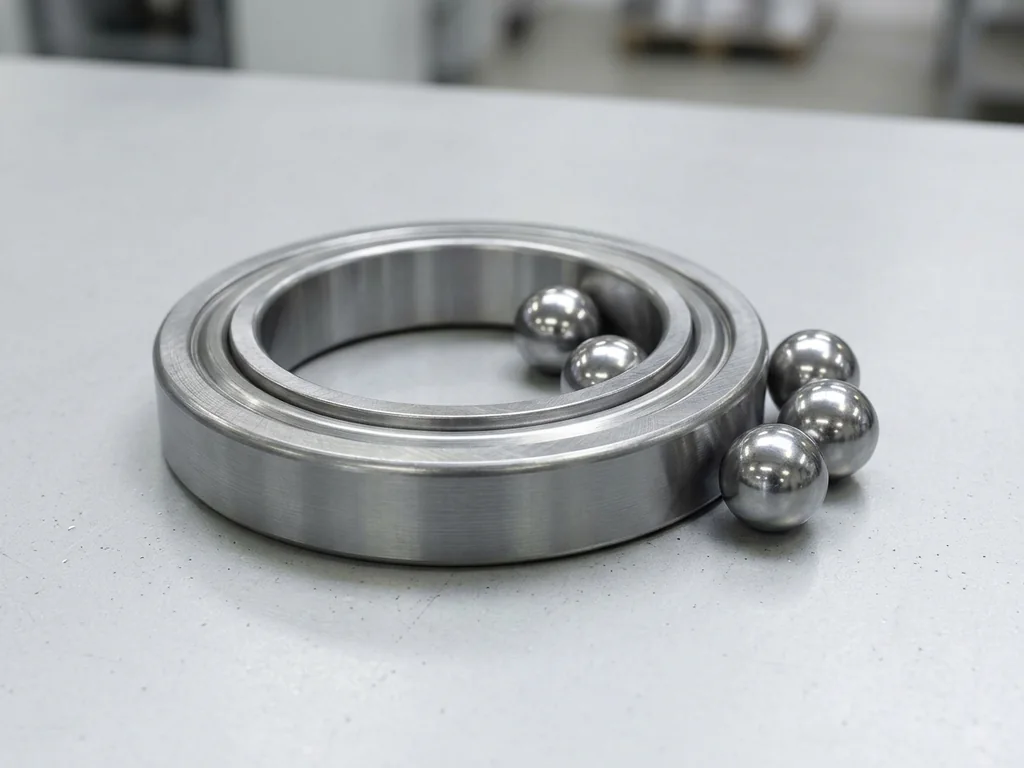
Bearing Steel E52100 / SUJ2
Yield: 1400–1800 MPa; Tensile: 1600–2200 MPa; Density: 7.81 g/cm³.
Typical condition: Spheroidised annealed (≈200 HB) / Quenched & tempered. Confirm the grade, supplier data and test conditions for each order.
Hardness: 60–66 HRC.
Typical uses: Rolling-bearing rings and rollers, ball screws, precision shafts and spindles, gauges, die guide pillars, fuel injector nozzles
Features: Dimensional Stability
Source handbook cost tier: $$ across its material table; not a within-family ranking or a quote.
Process references (confirm for the project): CNC turning, milling (annealed); grinding (primary process after hardening);superfinishing;polishing
Material limitations: Poor corrosion resistance (not stainless); extremely poor weldability; only fair machinability in annealed state; not for high-temperature service
Steel (Die / Mould)
Pre-Hardened Mould Steel for Plastics P20
Yield: 800–1000 MPa; Tensile: 1000–1250 MPa; Density: 7.85 g/cm³.
Typical condition: Pre-hardened 28–35 HRC (supplied Q&T, ready to machine). Confirm the grade, supplier data and test conditions for each order.
Hardness: 28–35 HRC (≈280–330 HB).
Typical uses: Injection-mould bases and cavities, die-casting dies (zinc/aluminium, low volume), templates and fixtures, home-appliance and automotive plastics moulds
Features: Dimensional Stability
Relative cost within Steel (Die / Mould): ★☆☆☆☆ (source tier $$; ordinal reference, not a quote).
Process references (confirm for the project): CNC milling, turning, drilling (machinable directly in pre-hardened state, no further heat treatment); EDM;polishing
Material limitations: Limited hardness ceiling (wear resistance inferior to hardened steel); large complex moulds show only fair polish uniformity
Pre-Hardened Mirror-Polish Mould Steel 718H
Yield: 950–1150 MPa; Tensile: 1150–1350 MPa; Density: 7.85 g/cm³.
Typical condition: Pre-hardened 33–38 HRC. Confirm the grade, supplier data and test conditions for each order.
Hardness: 33–38 HRC (≈310–360 HB).
Typical uses: Large home-appliance and automotive plastics moulds (bumpers/dashboards/door panels), high-gloss blemish-free moulds, transparent-part moulds
Characteristics: Pre-hardened mold steel with good polishability and machining characteristics.
Relative cost within Steel (Die / Mould): ★★★☆☆ (source tier $$$; ordinal reference, not a quote).
Process references (confirm for the project): CNC milling, turning, deep-hole drilling (machined directly in pre-hardened state); EDM;mirror polishing
Material limitations: Higher cost than P20; limited hardness ceiling; large parts need distortion and stress-relief control
Corrosion-Resistant Mirror-Polish Mould Steel S136
Tensile: After Q&T: 1500–1900 MPa; Density: 7.75 g/cm³.
Typical condition: Annealed (≈215 HB) / Quenched & tempered 48–52 HRC. Confirm the grade, supplier data and test conditions for each order.
Hardness: 48–52 HRC (≈460–520 HB).
Typical uses: Transparent-part (optical lens/light-guide plate) moulds, PVC and corrosive-plastics moulds, medical-device moulds, food-packaging moulds
Features: Dimensional Stability
Relative cost within Steel (Die / Mould): ★★★★★ (source tier $$$$; ordinal reference, not a quote).
Process references (confirm for the project): CNC milling, turning (rough machining in annealed state → hardening → grinding); CNC milling, turning (rough machining in annealed state → hardening → grinding);mirror polishing;EDM
Material limitations: High cost; only fair machinability in annealed state; narrow quench-temper process window; lower toughness than non-stainless mould steels
Steel (Special Alloy)

Invar 36 Alloy 4J36
Yield: 240–280 MPa; Tensile: 450–590 MPa; Density: 8.10 g/cm³.
Typical condition: Annealed / Solution-treated. Confirm the grade, supplier data and test conditions for each order.
Hardness: 130–180 HB.
Typical uses: Precision instruments and gauge reference parts, LNG tank liners, clocks and resonant cavities, aerospace composite-material moulds, optical and laser cavities
Characteristics: Very low thermal expansion near room temperature; suitable for dimensional stability.
Source handbook cost tier: $$$$ across its material table; not a within-family ranking or a quote.
Process references (confirm for the project): CNC milling, turning (Ni-based, tends to seize/galling, needs dedicated parameters); sheet-metal stamping, bending; welding (TIG, matching filler required)
Material limitations: Expensive; poor thermal conductivity, severe work-piece adhesion (built-up edge) in cutting; low-expansion property lost above ≈200 °C; only fair corrosion resistance (not stainless)
Copper
Oxygen-Free Copper C101 (T2)
Yield: 100–400 MPa; Tensile: 200–450 MPa; Density: 8.94 g/cm³.
Typical condition: Annealed O / Hard H. Confirm the grade, supplier data and test conditions for each order.
Hardness: 60–100 HB.
Typical uses: Busbars and conductive terminals, high-frequency / vacuum electronic devices, heat sinks and vapour chambers, waveguides and resonant cavities, welding electrodes, vacuum seals
Features: Ductility
Relative cost within Copper: ★☆☆☆☆ (source tier $$$; ordinal reference, not a quote).
Process references (confirm for the project): CNC milling, turning (soft, gummy — use sharp tools with large rake angle); sheet-metal stamping, bending, spinning; brazing / hydrogen brazing (oxygen-free copper free from hydrogen-embrittlement risk)
Material limitations: Soft, easily deformed, tight tolerances hard to hold; built-up edge in cutting, surface roughness hard to control; high cost, high density
Oxygen-Free Copper C103 (T1)
Yield: 100–380 MPa; Tensile: 200–430 MPa; Density: 8.94 g/cm³.
Typical condition: Annealed O / Hard H. Confirm the grade, supplier data and test conditions for each order.
Hardness: 55–90 HB.
Typical uses: High-frequency connectors and coaxial parts, electrical terminals, brazed assemblies, electronic component leads, heat-exchange components
Features: Ductility
Relative cost within Copper: ★☆☆☆☆ (source tier $$$; ordinal reference, not a quote).
Process references (confirm for the project): CNC milling, turning; sheet-metal stamping, deep drawing; sheet-metal stamping, deep drawing;spinning; brazing (phosphor copper self-fluxes well)
Material limitations: Low strength; built-up edge in cutting; high cost; trace phosphorus lowers conductivity
Oxygen-Free Copper C103 (TU2)
Yield: 110–370 MPa; Tensile: 210–420 MPa; Density: 8.94 g/cm³.
Typical condition: Annealed O / Hard H. Confirm the grade, supplier data and test conditions for each order.
Hardness: 60–95 HB.
Typical uses: Heat exchangers and heat-sink fins, electrical connectors, vacuum and semiconductor chamber parts, welded structures, conductive springs
Features: Ductility
Relative cost within Copper: ★☆☆☆☆ (source tier $$$; ordinal reference, not a quote).
Process references (confirm for the project): CNC milling, turning; sheet-metal stamping, deep drawing; sheet-metal stamping, deep drawing;spinning; TIG/MIG welding;brazing
Material limitations: Low strength, easily deformed; poor machinability; high cost
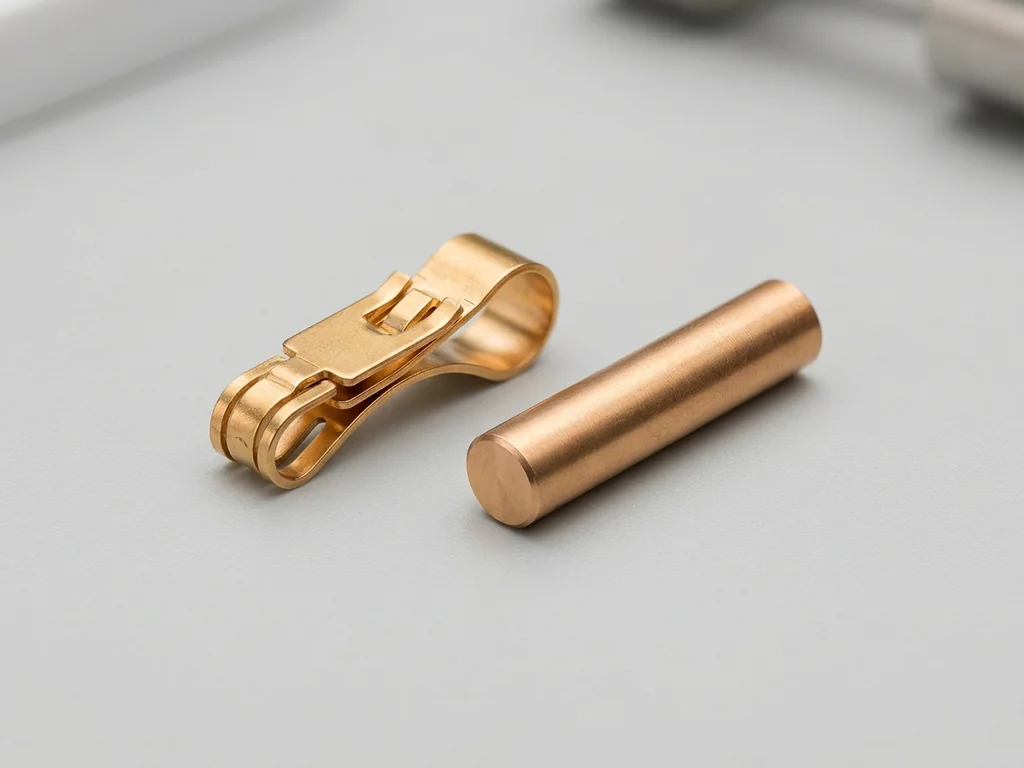
Beryllium Copper C17200 (BeCu)
Yield: 1035–1240 MPa; Tensile: 1240–1400 MPa; Density: 8.25 g/cm³.
Typical condition: Solution-treated A / Aged AT, HT (precipitation hardenable). Confirm the grade, supplier data and test conditions for each order.
Hardness: 36–42 HRC (≈340–400 HB).
Typical uses: Springs and contact fingers, connector terminals, explosion-proof non-sparking tools, mould inserts (high thermal conductivity), aerospace and medical devices
Features: Corrosion Resistance Fatigue Resistance
Relative cost within Copper: ★★★★★ (source tier $$$$$; ordinal reference, not a quote).
Process references (confirm for the project): CNC milling, turning, drilling (machine in solution-treated state → age); stamping / forming (solution-treated state); welding (requires protection, beryllium vapour toxic)
Material limitations: Beryllium dust / vapour toxic, machining requires strict protection; very expensive; ageing distortion requires stock allowance
Brass
Muntz Metal C28000
Yield: 255–345 MPa; Tensile: 380–520 MPa; Density: 8.53 g/cm³.
Typical condition: Hot-rolled / Annealed. Confirm the grade, supplier data and test conditions for each order.
Hardness: 75–95 HB.
Typical uses: Marine hardware and seawater piping, condenser tube plates, structural sections and plate, corrosion-resistant housings, architectural and decorative parts
Characteristics: Good hot-workability and seawater resistance in suitable conditions.
Source handbook cost tier: $$$ across its material table; not a within-family ranking or a quote.
Process references (confirm for the project): CNC turning, milling; sheet-metal bending (thick plate); brazing; hot working (hot rolling / hot extrusion, good hot plasticity)
Material limitations: Poor cold formability (brittle β phase); average machinability; dezincification corrosion requires attention
Bronze
Aluminium Bronze C95400
Yield: 250–310 MPa; Tensile: 550–680 MPa; Density: 7.45 g/cm³.
Typical condition: As-cast / Wrought. Confirm the grade, supplier data and test conditions for each order.
Hardness: 170–210 HB.
Typical uses: Heavy-duty bearings and bushes, worms and gears, marine propellers and pump bodies, valves and valve seats, chemical corrosion-resistant parts, wear plates
Characteristics: Good strength, wear resistance and seawater corrosion resistance.
Source handbook cost tier: $$$ across its material table; not a within-family ranking or a quote.
Process references (confirm for the project): CNC turning, milling (high hardness, requires carbide tools); grinding; welding (requires preheat 150–260 °C)
Material limitations: Fairly difficult to machine (high hardness, low thermal conductivity); high demands on casting and welding process; high cost
Silicon Bronze C65500
Yield: 125–250 MPa; Tensile: 350–550 MPa; Density: 8.53 g/cm³.
Typical condition: Annealed / Cold-worked (H). Confirm the grade, supplier data and test conditions for each order.
Hardness: 60–95 HB.
Typical uses: Chemical and marine structural parts, welded vessels and piping, springs and fasteners, bolts and marine hardware, sculpture and architecture
Features: Corrosion Resistance
Source handbook cost tier: $$$ across its material table; not a within-family ranking or a quote.
Process references (confirm for the project): CNC turning, milling; sheet-metal stamping, bending, spinning; welding (excellent TIG/MIG weldability);brazing
Material limitations: Electrical / thermal conductivity markedly lower than pure copper / brass; average machinability; high cost
Magnesium Alloys

AZ91D (Die-Casting Magnesium Alloy)
Yield: 150–160 MPa; Tensile: 230–280 MPa; Density: 1.81 g/cm³.
Typical condition: Die-cast F / T4 solution / T6 solution + ageing. Confirm the grade, supplier data and test conditions for each order.
Hardness: 60–70 HB.
Typical uses: Automotive steering-wheel frames and transmission housings, 3C product housings (laptop/mobile-phone midframes), aerospace housings, sports equipment, hand-tool housings
Features: Dimensional Stability
Source handbook cost tier: $$$$$ across its material table; not a within-family ranking or a quote.
Process references (confirm for the project): CNC milling, drilling, tapping (secondary finishing); High-pressure die casting (primary)
Material limitations: Flammable (chips/dust); low toughness, brittle (elongation only 3–7%); poor corrosion resistance requiring coating; insufficient high-temperature strength
Titanium Alloys
TA1 / Gr1 Commercially Pure Titanium
Yield: 170–275 MPa; Tensile: 240–370 MPa; Density: 4.51 g/cm³.
Typical condition: Annealed condition. Confirm the grade, supplier data and test conditions for each order.
Hardness: 120–160 HB.
Typical uses: Chemical heat exchangers and reactor linings, desalination equipment, medical implants and dentistry, electroplating racks, deep-drawn parts, aerospace sheet-metal parts
Features: Corrosion Resistance
Source handbook cost tier: $$$$$ across its material table; not a within-family ranking or a quote.
Process references (confirm for the project): CNC milling, turning (low cutting speed 40–70 m/min + ample coolant); sheet metal stamping, bending, spinning (best formability); TIG welding
Material limitations: Lowest-strength titanium; poor thermal conductivity causes high cutting-zone temperature, fast tool wear; readily reacts with tool material (coated carbide recommended)
TA2 / Gr2 Commercially Pure Titanium
Yield: 275–380 MPa; Tensile: 345–480 MPa; Density: 4.51 g/cm³.
Typical condition: Annealed condition. Confirm the grade, supplier data and test conditions for each order.
Hardness: 160–200 HB.
Typical uses: Pressure vessels and tanks, chemical piping and valves, marine and seawater systems, medical implants, plate heat exchangers, aerospace structural parts, sports equipment
Features: Corrosion Resistance
Source handbook cost tier: $$$$$ across its material table; not a within-family ranking or a quote.
Process references (confirm for the project): CNC milling, turning, drilling; grinding and polishing; sheet metal stamping, bending, roll bending; TIG/MIG/plasma welding
Material limitations: Poor thermal conductivity (16 W/m·K) makes machining difficult, high tool cost; prone to galling; expensive
Commodity Plastics

PC/ABS Alloy
Yield: 55–60 (yield) MPa; Tensile: 55–70 MPa; Density: 1.13 g/cm³.
Typical condition: Injection-moulding grade / extruded sheet. Confirm the grade, supplier data and test conditions for each order.
Hardness: R110–118 / Shore D 82–88.
Typical uses: Automotive dashboards and interior parts, laptop/mobile phone housings, medical device enclosures, electrical enclosures, charger and adapter housings
Features: Dimensional Stability
Relative cost within Commodity Plastics: ★★★★★ (source tier $$; ordinal reference, not a quote).
Process references (confirm for the project): CNC milling, turning, drilling, tapping; adhesive bonding (solvent/adhesive);ultrasonic welding; injection moulding; hot bending/thermoforming
Material limitations: Moderate chemical resistance (prone to stress cracking); strict drying required; higher cost than ABS; long-term heat resistance still inferior to PC

Flame-Retardant ABS (FR-ABS)
Yield: 38–45 (yield) MPa; Tensile: 40–50 MPa; Density: 1.16 g/cm³.
Typical condition: Injection-moulding grade / extruded sheet. Confirm the grade, supplier data and test conditions for each order.
Hardness: R100–110 / Shore D 78–85.
Typical uses: Electrical and electronic enclosures (sockets/switches/distribution boxes), monitor and TV rear housings, internal appliance components, battery cases, instrument housings
Features: Dimensional Stability Electrical Insulation
Relative cost within Commodity Plastics: ★★★★★ (source tier $$; ordinal reference, not a quote).
Process references (confirm for the project): CNC milling, turning, drilling, tapping; adhesive bonding (solvent/adhesive);ultrasonic welding; injection moulding (processing temperature lower than standard ABS to prevent flame-retardant decomposition); hot bending/thermoforming
Material limitations: Impact toughness and elongation lower than standard ABS; narrow processing-temperature window (flame retardant prone to decomposition); higher cost; moderate weather resistance

PP+GF30 (Glass-Fibre Reinforced)
Yield: 55–75 (yield) MPa; Tensile: 60–90 MPa; Density: 1.12 g/cm³.
Typical condition: Injection-moulding grade. Confirm the grade, supplier data and test conditions for each order.
Hardness: R105–115 / Shore D 82–88.
Typical uses: Automotive fans and brackets, appliance structural parts, power-tool housings, chemical-equipment components, pump bodies and impellers, metal-replacement parts
Features: Chemical Resistance Heat Resistance Cost Effective
Relative cost within Commodity Plastics: ★☆☆☆☆ (source tier $; ordinal reference, not a quote).
Process references (confirm for the project): CNC milling (glass fibre is highly abrasive); injection moulding
Material limitations: Elongation drops markedly (more brittle); glass-fibre exposure; strong abrasion to tooling; reduced low-temperature impact
Engineering Plastics

PC+GF30 (Glass-Fibre Reinforced)
Yield: 110–130 (yield) MPa; Tensile: 110–140 MPa; Density: 1.43 g/cm³.
Typical condition: Injection-moulding grade. Confirm the grade, supplier data and test conditions for each order.
Hardness: M90 / R120 / Shore D 88–92.
Typical uses: High-stiffness structural brackets; metal replacement parts; electrically insulating structural components; automotive functional parts; precision equipment frames
Features: Creep Resistance Dimensional Stability Heat Resistance
Relative cost within Engineering Plastics: ★★★★★ (source tier $$$; ordinal reference, not a quote).
Process references (confirm for the project): CNC milling, drilling (high glass-fibre abrasiveness, requires diamond/PCD tooling); injection moulding
Material limitations: Greatly reduced impact toughness; glass-fibre bloom on surface, poor appearance; high tool abrasiveness; pronounced anisotropy (warpage)
POM-H (Homopolymer Acetal / Delrin)
Yield: 70–75 (yield) MPa; Tensile: 70–78 MPa; Density: 1.42 g/cm³.
Typical condition: Extruded rod / sheet / injection-moulding grade. Confirm the grade, supplier data and test conditions for each order.
Hardness: R120 / Shore D 83–88.
Typical uses: High-precision gears and worm wheels; bearing cages; automotive fuel-system components; zippers; sprayer valve parts; precision machinery and watch components
Features: Creep Resistance Dimensional Stability Fatigue Resistance
Relative cost within Engineering Plastics: ★★★☆☆ (source tier $$; ordinal reference, not a quote).
Process references (confirm for the project): CNC turning, milling (excellent machinability, mirror finish achievable); injection moulding
Material limitations: Prone to centre porosity (thick sections); heat and chemical resistance slightly inferior to POM-C; formaldehyde release; slightly higher cost
PA66 (Nylon 66)
Yield: 80–95 (dry as moulded) MPa; Tensile: 80–95 MPa; Density: 1.15 g/cm³.
Typical condition: Extruded sheet and rod / injection-moulding grade. Confirm the grade, supplier data and test conditions for each order.
Hardness: Shore D 80–85 / R118.
Typical uses: Automotive under-hood parts and intake manifolds; gears and bearing cages; electrical connectors and terminal blocks; cable ties; industrial wear parts
Features: Creep Resistance Heat Resistance
Relative cost within Engineering Plastics: ★★★☆☆ (source tier $$; ordinal reference, not a quote).
Process references (confirm for the project): CNC milling, turning, drilling, tapping; ultrasonic welding; injection moulding (good flow, suitable for thin walls)
Material limitations: Still high moisture absorption (dimensional variation); poor toughness in DAM state, requires conditioning; weak acid resistance; must be dried before processing

PA66+GF30 (Glass-Fibre Reinforced Nylon)
Yield: 130–150 (yield) MPa; Tensile: 170–200 MPa; Density: 1.38 g/cm³.
Typical condition: Injection-moulding grade. Confirm the grade, supplier data and test conditions for each order.
Hardness: Shore D 85–90 / R120.
Typical uses: Automotive structural parts and brackets; power-tool housings; gears and bearing seats; sports equipment; radiator header tanks; industrial load-bearing parts
Features: Creep Resistance Dimensional Stability Heat Resistance
Relative cost within Engineering Plastics: ★★★☆☆ (source tier $$; ordinal reference, not a quote).
Process references (confirm for the project): CNC milling, drilling (high glass-fibre abrasiveness, requires PCD/diamond tooling); injection moulding
Material limitations: Elongation at break greatly reduced (brittle); glass-fibre bloom affects appearance and feel; high tool and mould abrasiveness; pronounced anisotropic warpage
High-Performance Plastics

PEEK-GF30 / PEEK-CA30
Yield: 150–165 (yield) MPa; Tensile: 155–175 MPa; Density: 1.45 g/cm³.
Typical condition: Injection-moulding grade / extruded rod and sheet. Confirm the grade, supplier data and test conditions for each order.
Hardness: Shore D 88–92 / R127.
Typical uses: Semiconductor and vacuum-chamber parts; downhole oil and gas seals and wear parts; aerospace brackets and clamps; racing drivetrain parts; high-temperature bearings and bushings
Features: Creep Resistance Dimensional Stability
Relative cost within High-Performance Plastics: ★★★★★ (source tier $$$$$; ordinal reference, not a quote).
Process references (confirm for the project): CNC milling, turning (high carbon-fibre/glass-fibre abrasiveness, requires PCD tooling); injection moulding (380–420 °C)
Material limitations: Extremely high cost; very low elongation at break (2–3%), brittle; carbon-fibre grade is conductive (unsuitable where insulation required); high tool abrasiveness

PEI (Polyetherimide / ULTEM 1000)
Yield: 100–110 (yield) MPa; Tensile: 105–125 MPa; Density: 1.27 g/cm³.
Typical condition: Extruded sheet and rod / injection-moulding grade. Confirm the grade, supplier data and test conditions for each order.
Hardness: M109–112 / R120 / Shore D 85–90.
Typical uses: Aerospace interior parts (flame-retardant, low smoke/toxicity); reusable medical instruments (steam-sterilisation resistant); electrical insulation parts; semiconductor fixtures; 3D printing (FDM)
Features: Creep Resistance Dimensional Stability Flame Resistance
Relative cost within High-Performance Plastics: ★★★☆☆ (source tier $$$; ordinal reference, not a quote).
Process references (confirm for the project): CNC milling, turning (high toughness, requires sharp tooling + cooling); injection moulding (barrel 340–400 °C, mould 140–175 °C)
Material limitations: High cost (next only to PEEK tier); narrow processing-temperature window; poor resistance to strong alkalis and some solvents; amber colour limits colour options
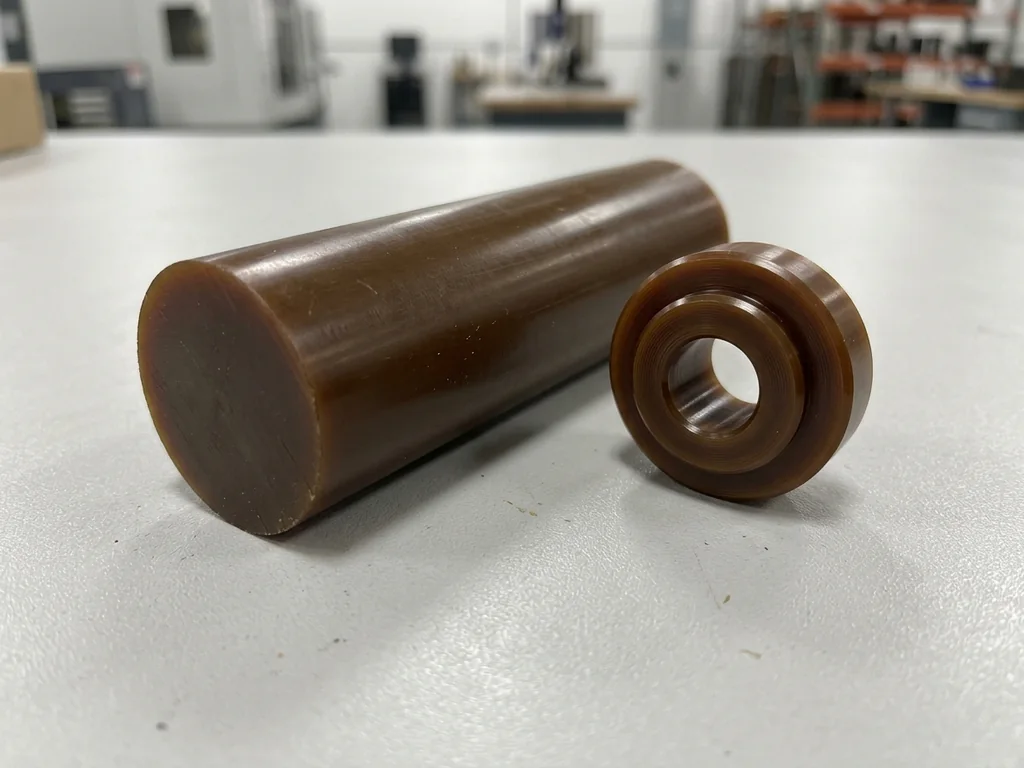
PAI (Polyamide-Imide / Torlon)
Yield: 150–160 (yield) MPa; Tensile: 150–190 MPa; Density: 1.40 g/cm³.
Typical condition: Compression-moulded rod and sheet / injection-moulding grade (requires post-cure). Confirm the grade, supplier data and test conditions for each order.
Hardness: M109–113 / E78–85 / Shore D 90–95.
Typical uses: High-temperature bearings and bushings (oil-free lubrication); seal rings and piston rings; electrical connectors and insulation parts; aerospace structural parts; semiconductor equipment parts; compressor valve plates
Features: Creep Resistance Flame Resistance
Relative cost within High-Performance Plastics: ★★★★★ (source tier $$$$$; ordinal reference, not a quote).
Process references (confirm for the project): CNC turning, milling, grinding (high hardness, requires carbide/PCD tooling); long post-cure required after injection moulding; compression moulding
Material limitations: Extremely high cost; long post-cure mandatory (long cycle, high cost); difficult to process; single colour (yellow-brown/black); requires drying after moisture absorption
Thermosets

Bakelite (Phenolic)
Yield: — (brittle; no yield point) MPa; Tensile: 70–100 MPa; Density: 1.40 g/cm³.
Typical condition: Laminate / rod / moulded part. Confirm the grade, supplier data and test conditions for each order.
Hardness: R110–120 / Shore D 90–95.
Typical uses: Electrical switches and socket panels, terminal blocks and busbar connectors, circuit-breaker parts, motor and transformer insulation, cookware handles, grinding-wheel bodies
Features: Dimensional Stability Electrical Insulation Flame Resistance Heat Resistance Cost Effective
Source handbook cost tier: $$ across its material table; not a within-family ranking or a quote.
Process references (confirm for the project): CNC milling, turning, sawing (brittle, high dust); die cutting (thin sheet); compression moulding
Material limitations: Extremely brittle, no elasticity (elongation <1%); not recyclable (thermoset); machining dust is hazardous, dust extraction required; not resistant to strong alkalis; limited appearance options
Composites

FR-4 (Epoxy Glass-Fibre Laminate)
Tensile: 340 (warp direction) MPa; Density: 1.85 g/cm³.
Typical condition: Copper-clad laminate (CCL) / laminated insulating board. Confirm the grade, supplier data and test conditions for each order.
Hardness: R110 / M110.
Typical uses: Printed circuit board (PCB) substrate, electrical insulating spacers and gaskets, busbar clamps and terminal boards, transformer and motor insulation, fixtures and carriers
Features: Chemical Resistance Dimensional Stability Electrical Insulation
Source handbook cost tier: $ across its material table; not a within-family ranking or a quote.
Process references (confirm for the project): CNC milling, drilling, routing (must use carbide/diamond tooling + dust extraction); die cutting (thin sheet)
Material limitations: Machining dust contains glass fibre (hazardous; dust extraction and protection required); high Z-direction thermal expansion (prone to delamination); not recyclable; anisotropic; not suitable for high-frequency/high-speed use (relatively high dielectric constant)
Results: